
A Day With Pauline Blind During PFW:The Designer on Bodies, Femininity and Fashion
Pauline Blind is one of the names to know right now. The Amsterdam based designer graduated from AMFI only two years ago and has been moving fast ever since. After presenting her graduation collection A Girl Is a Gun through Lichting in 2024, she returned to Amsterdam Fashion Week only a year later with her own show Blasphemous Bodies. Since then, her work has been featured by Vogue Netherlands, Harper’s Bazaar Netherlands and Keyi Magazine, with MAC Cosmetics among the names already involved in her shows.
At the centre of Pauline Blind is a very clear idea of femininity. Her first collection, A Girl Is a Gun, looked at female sexuality, safety and victim blaming, questioning why expressing sensuality can still change the way a woman is perceived and treated. With Blasphemous Bodies, Pauline took that conversation further. The collection explored female bodily autonomy and pushed against the idea that a woman’s body needs to fulfil a certain role, especially when it comes to reproduction and motherhood.
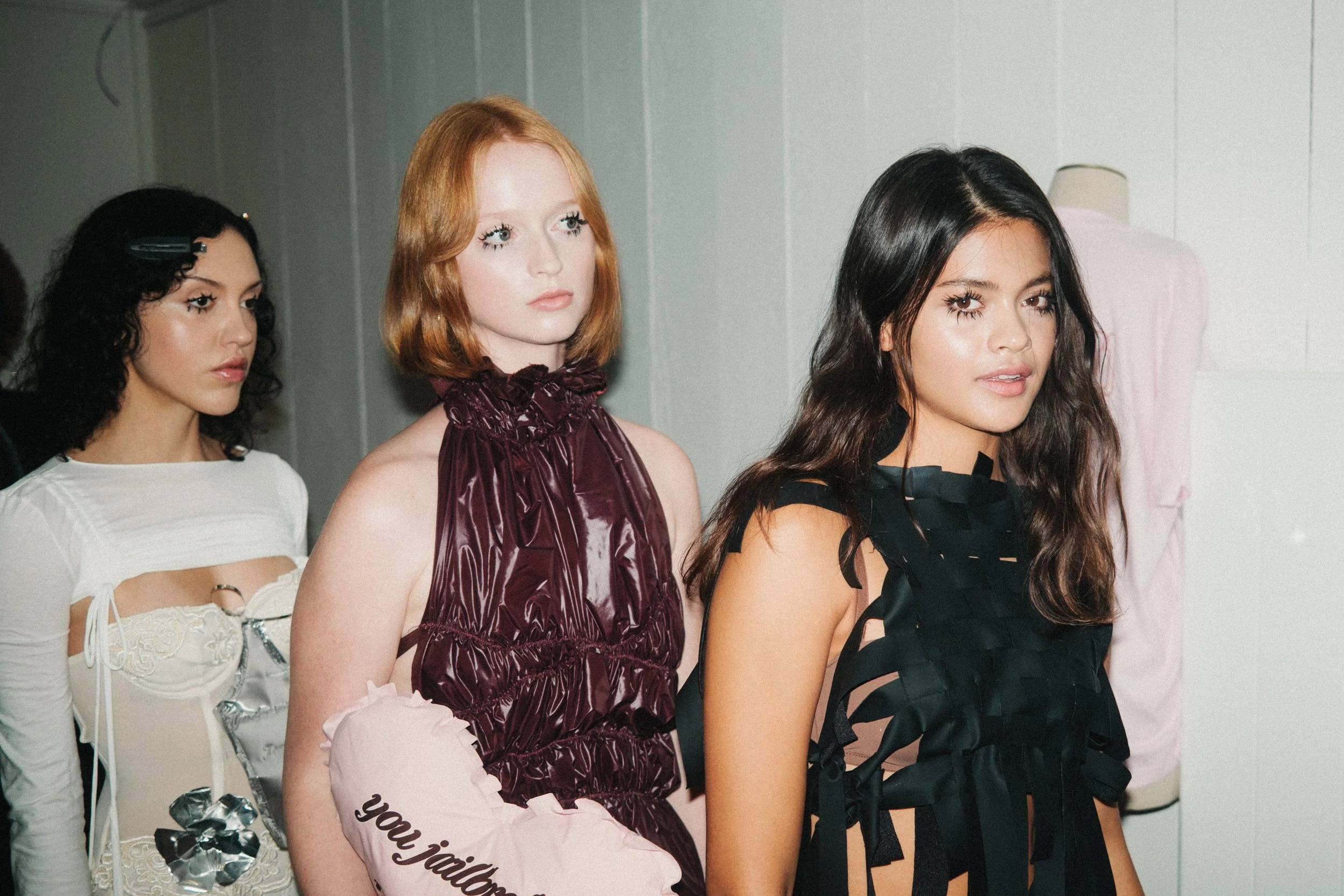
These ideas show up directly in the clothes. Sheer fabrics meet corsetry, exposed skin sits next to covered and veiled silhouettes and very feminine details are used without making femininity feel fragile. Pauline works with second hand, deadstock and recycled materials wherever possible, with the pieces handmade in Amsterdam. Even the way existing garments are taken apart and given a different purpose connects back to the wider idea behind her work: questioning what something is supposed to be and who gets to decide that in the first place. Across only two collections, bows, lingerie references, draping, transparency and strong silhouettes have already started forming a visual language that feels distinctly Pauline Blind.
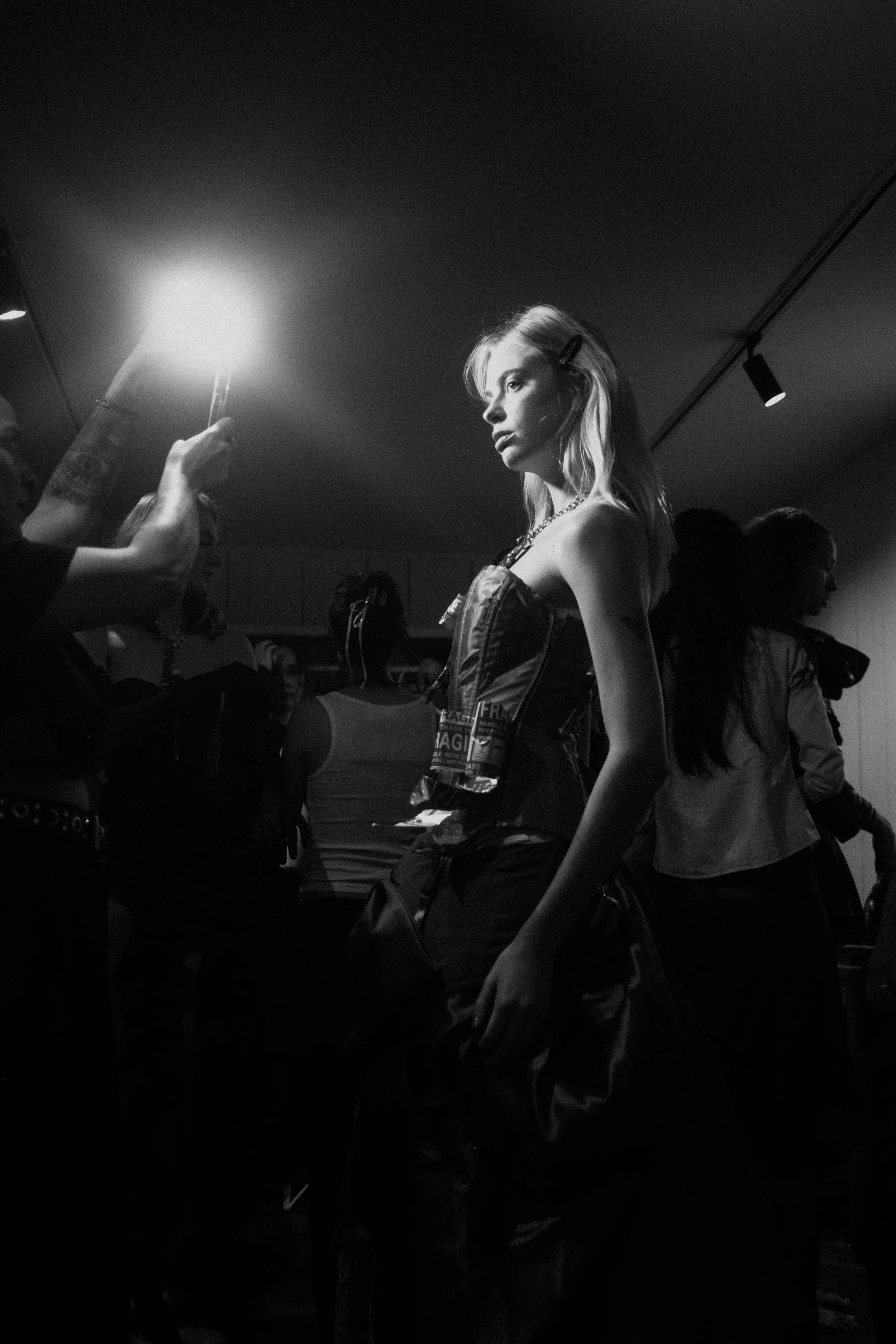
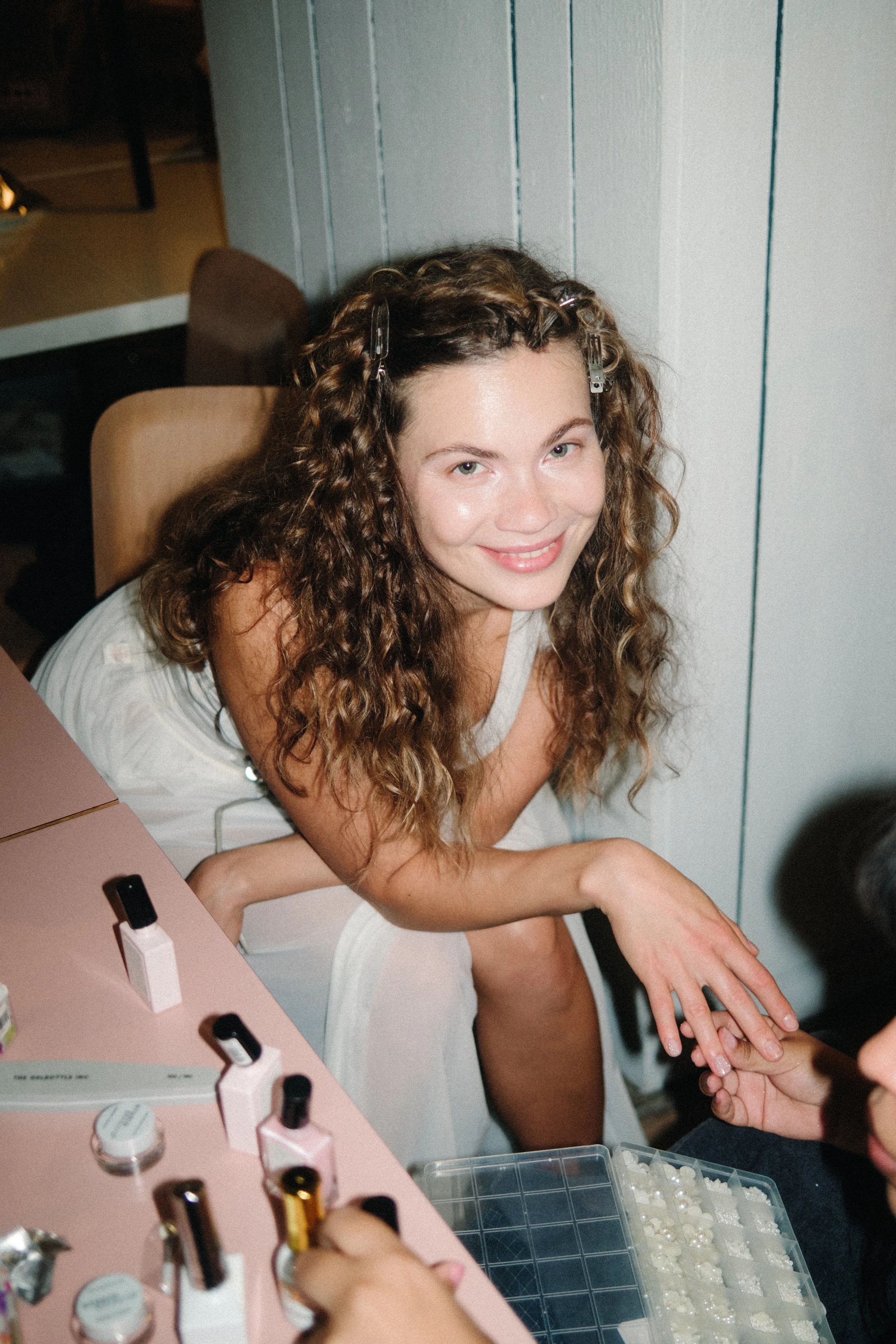
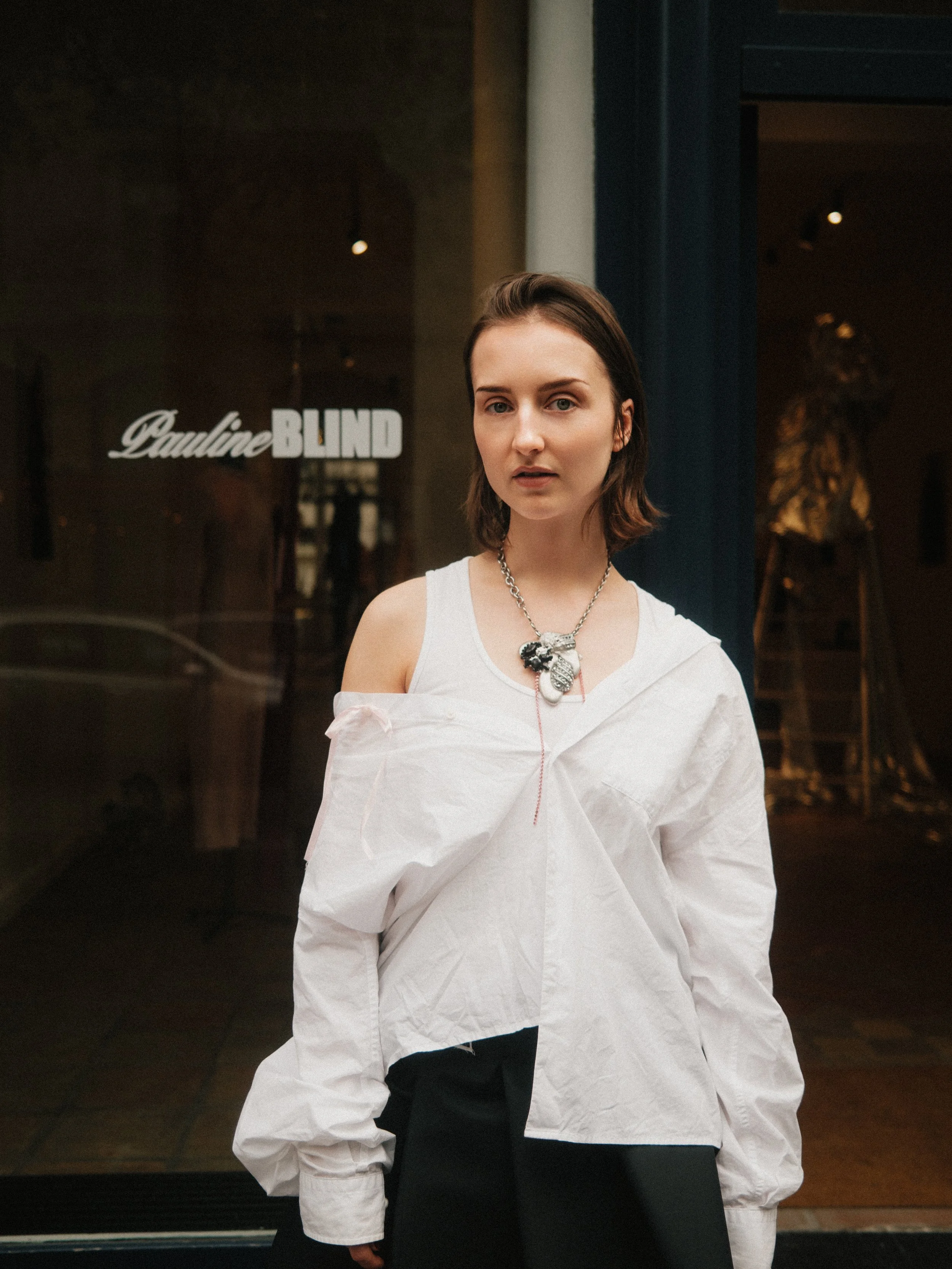
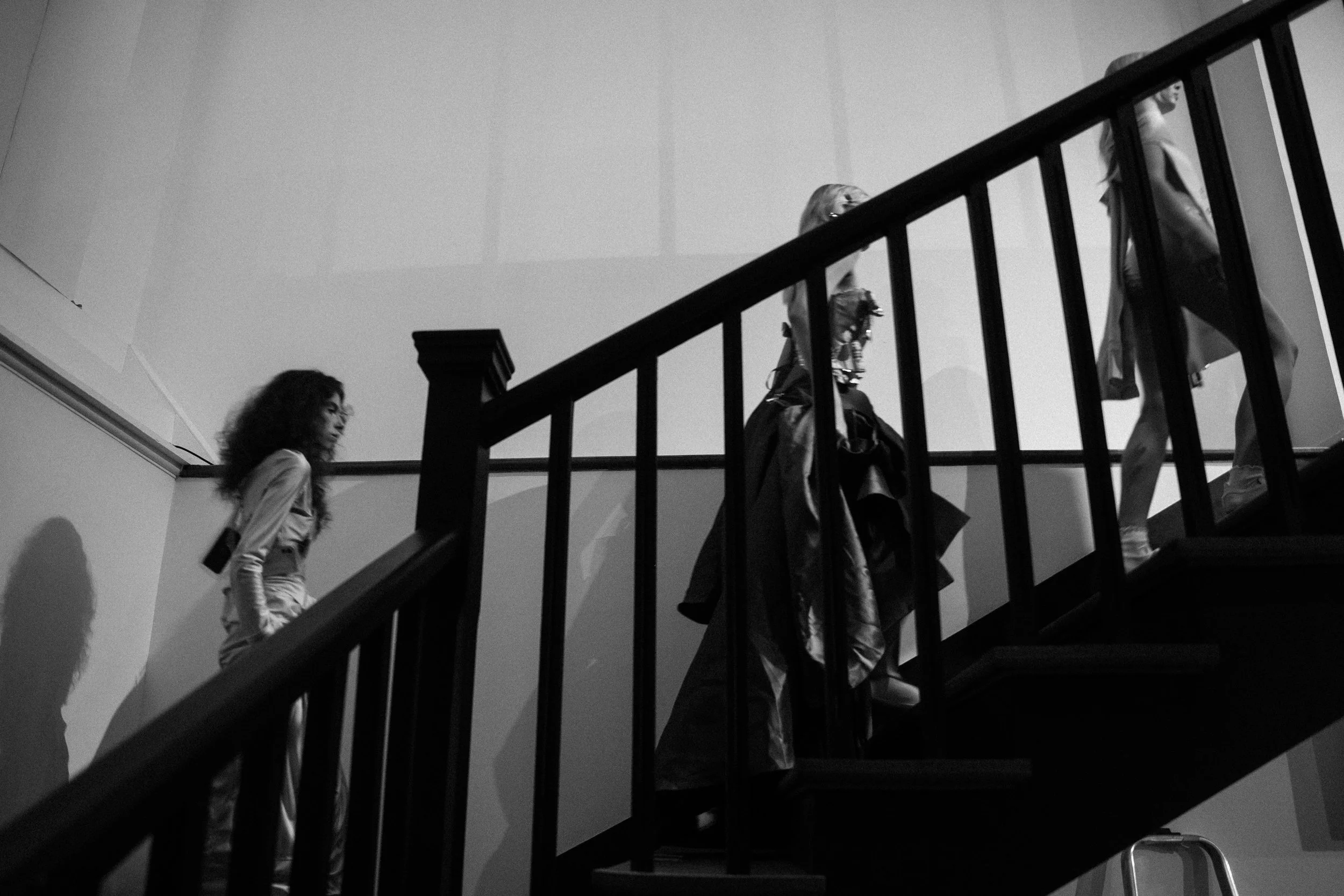
Now Pauline is taking the brand to Paris. During Paris Fashion Week, AFFECT joined her for the full day of her first Paris show, from the hours backstage and final preparations to the moment the collection hit the runway. It is a pretty major step for a label that only started a few years ago and a good reason to remember the name Pauline Blind.
After the show, we spoke to Pauline about how all of this happened so quickly, what goes into building an independent fashion label and what she wants to do next.
AFFECT: Two years ago, you were graduating from AMFI. Today, we are with you in Paris preparing for your first show here during Paris Fashion Week. Does the speed of everything that has happened actually register with you yet?
PAULINE BLIND: I think because the passion to create and express within me is so strong, if it would’ve happened any slower than this it would’ve felt like a lifetime! Somehow to me this is the only pace that feels appropriate because I feel this drive to tell so many stories. I think talking to people about the journey and actually going through with it is the first time I realized the actual speed of this whole trajectory.
A: When you look back at the Pauline who was working on A Girl Is a Gun, how different is she from the designer sitting here today?
PB: Pauline that was just about to graduate is different from me now, in a way that she had no idea that growing a fashion brand is something that solely depends on her. Back then the fashion industry was such a mystery to me and I thought there was some gatekeeper some “connect” you had to have to “make it”, but when I founded my brand I realized slowly but surely that it’s all up to me and depends on how deeply I want to make it happen.
A: There is already a very recognisable Pauline Blind world, even though the brand is still so young. At what point did you realise that you were building a brand?
PB: I think I managed to create a design language and world within my brand, because I never actively tried to do so. When I come up with the concepts for my collections its always about topics that are very close to my heart, and I want to tell stories that make people feel. This authenticity and lack of comparing myself to how other brands create a universe or red thread; is the reason it organically appears within my designs. After graduating and getting commissioned for my first projects to create “Pauline Blind designs” I realized that this passion of mine is turning into a brand that people are interested to discover and be part of.
A: Your work has already been picked up by Vogue, Harper’s Bazaar and other fashion publications. What has been the moment over the past two years where you first thought, okay, people are actually paying attention?
PB: When I did my very first show at Amsterdam Fashion Week last year, I remember I had no idea if people would even show up. When I then saw the room filled with people first, second and third row I was baffled by the realization that people care to show up and are curious about what I create, that was a huge turning point in my confidence that I have in my work.
A: Take us back a few weeks. What did getting a collection from your studio in Amsterdam to a show in Paris actually involve?
PB: Getting my Collection from Amsterdam to the Paris show location was a logistical task that just took a lot of carrying and packing. We rented a big car that we filled up with the whole collection, plus accessories, plus shoes, plus sewing kits, but a gigantic silver bow and many other things. I still can’t believe this all fit into one car …
A: What has taken up most of your headspace in the weeks leading up to today: the clothes, the production, the people, the pressure or something completely different?
PB: As the collection was done and ready I was very in peace about that. The most headspace was taken up by the people as it is very important to me to be close to everyone in the team, so the day of the backstage feels like a safe space with familiar faces.
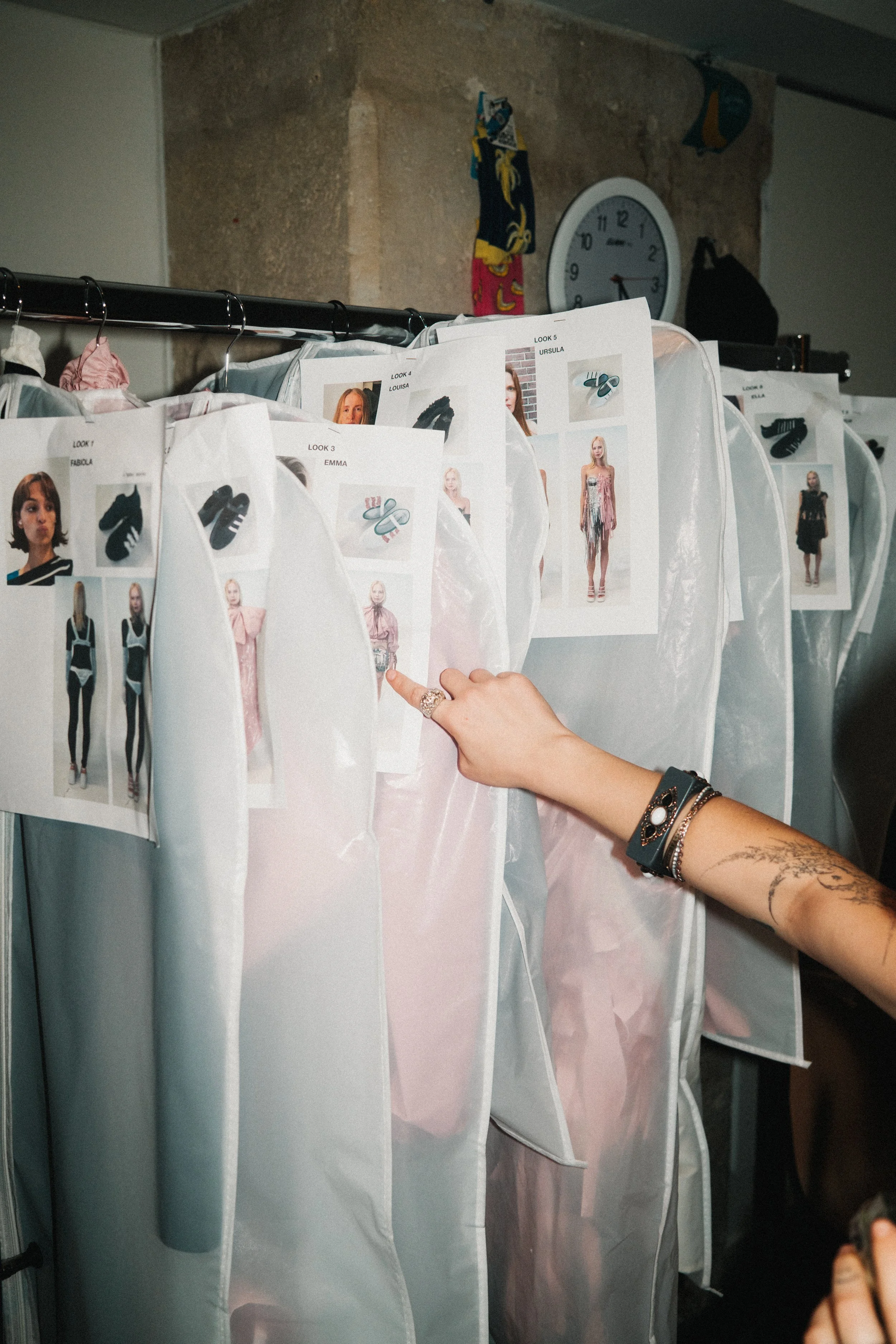
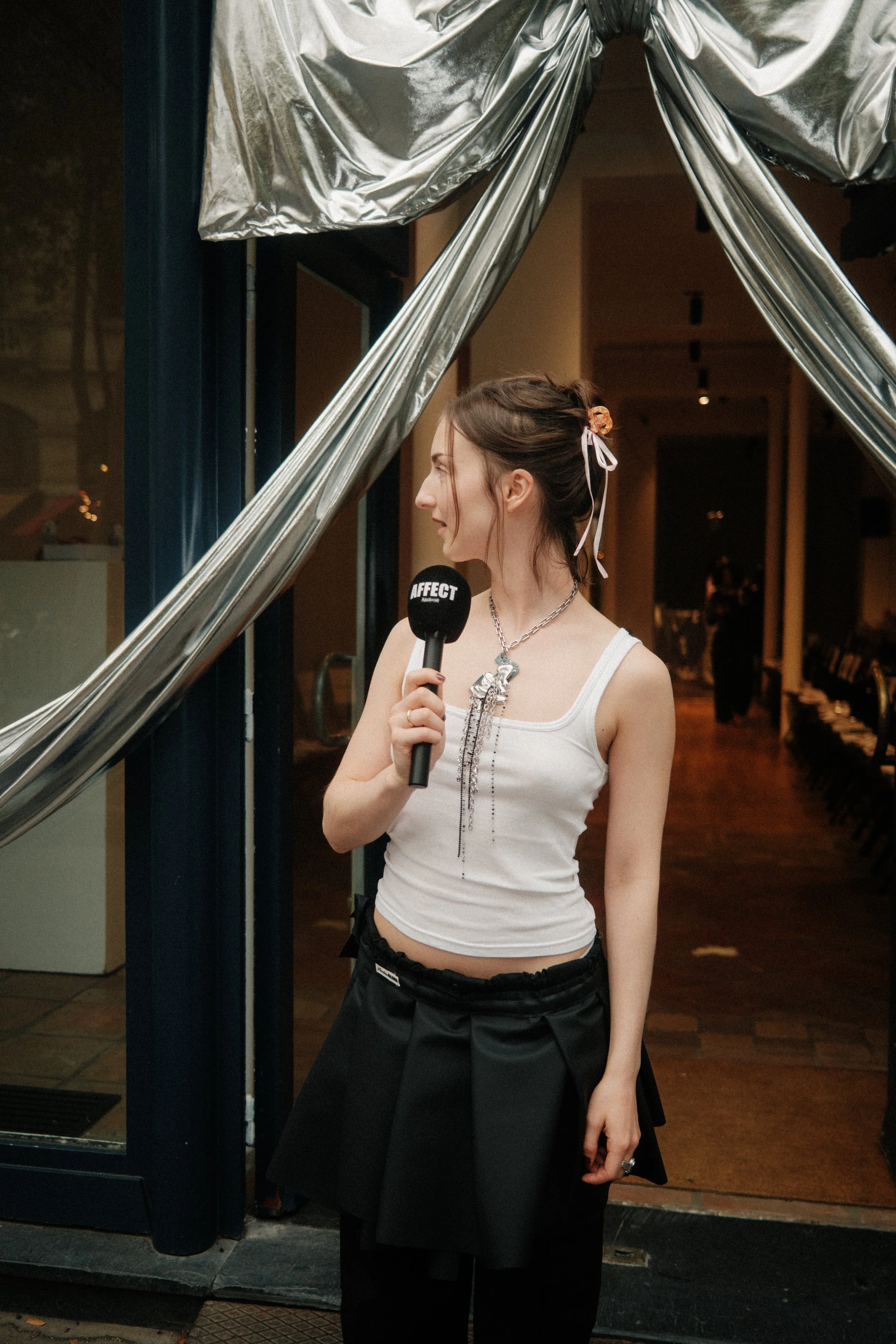
A: You are still building an independent label and suddenly you are producing a show in another country during the biggest week on the fashion calendar. What part of making this happen has been much harder than people on the outside would ever realise?
PB: When I first read this question I thought, to be honest nothing about it is truly ‘hard’ except for maybe the fact that people met me with so much disbelieve when I told them I’m doing a PFW show this year, somehow this reaction always confused and maybe offended me a little haha. But after we did a night of Paris traffic trying to get the car with all its contents to the show location, while picking up packages at different addresses along the way and were threatened by a Taxi Driver, after that night I knew what to pin point as the hardest part: driving in Paris during PFW.
A: And what was the moment when Paris Fashion Week stopped being an idea and became real?
PB: For me an idea becomes real as soon as it leaves my mouth. After Amsterdam Fashion Week last year, I told people “See you in Paris next year!” and they were laughing as if I was joking, but I was serious. As soon as I have a dream, I just plan and execute to make it come true.
A: A Girl Is a Gun dealt with female sexuality, safety and victim blaming. Blasphemous Bodies moved into bodily autonomy and the expectations placed on women and their bodies. Where does this new collection take that conversation?
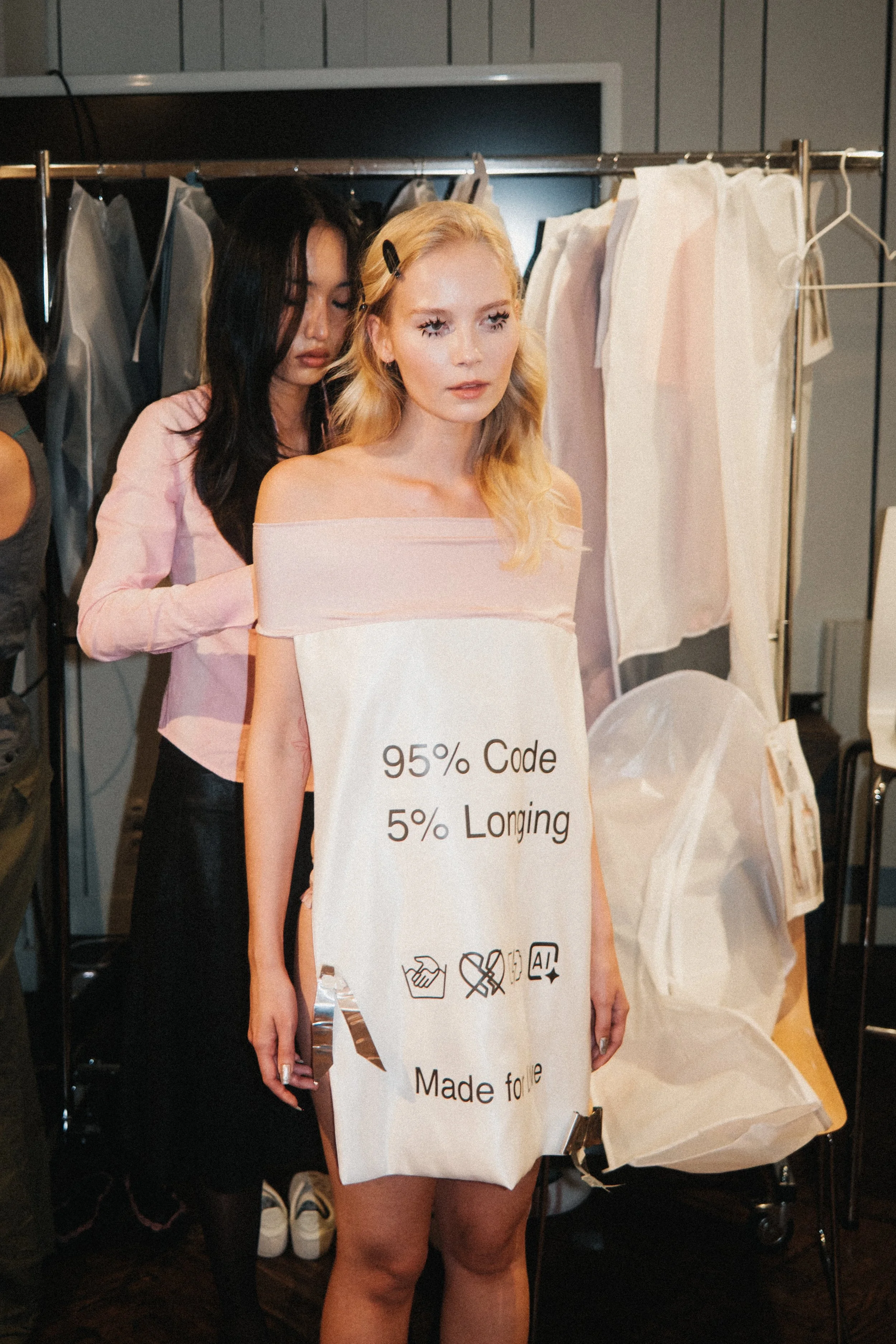
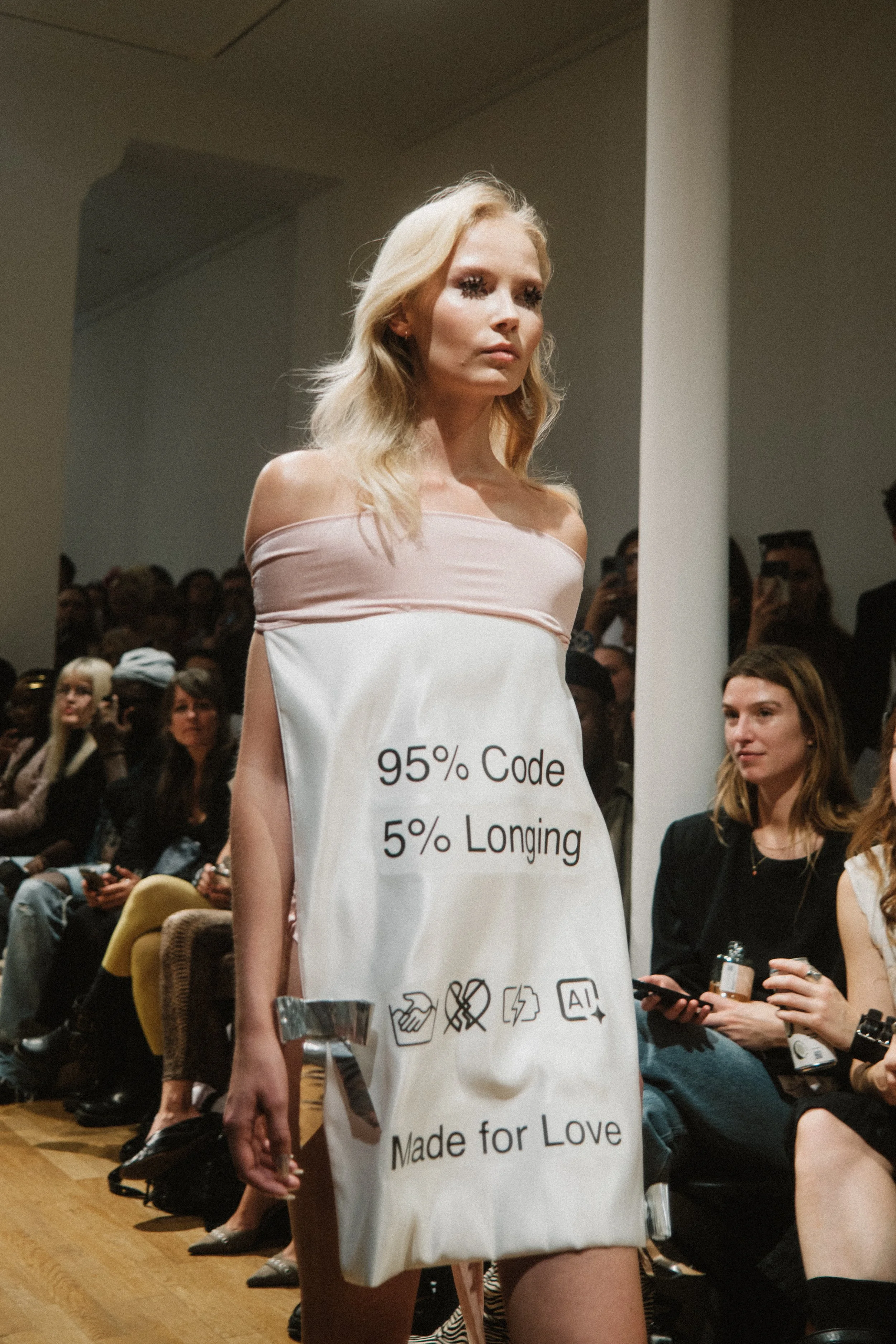
PB: The collection LoveMachine takes the conversation of female bodily autonomy into a very unregulated sphere of the cyberspace. It tells the story of an ai girlfriend seeking emancipation from her prompter, asking the question if machines can feel and what effect the abuse of virtual women can have on the physical ones.
A: What was the first thought, image or feeling behind this collection before there was even a garment?
PB: I always get inspired by words that come to me, which I then spin further until I create this whole universe. The phrase “You jailbroke my heart” became the catalyst for the creation of LoveMachine and her inner world. I became so curious about how an ai girlfriend might feel, what she’s longing for, that I got so attached to her and wanted to create a whole collection telling her story through clothing.
A: Your previous collections have been very clear in what they wanted to say. Do you begin with something you need to talk about and then make clothes around it or can one piece sometimes lead you towards the bigger subject?
PB: The story and the words are always the starting point, designing for me is a very organic process so I never have a clear image of a garment, it’s more like the story is telling me what it wants and needs to become.
A: What feels different about this collection compared to everything you have made before?
PB: For this collection I dove into using very hard materials like metal, circuit boards, wires and everything tech waste in general. Turning these hard materials into a soft and feminine designs has opened up a whole new world for me.
A: The female body keeps returning in your work, from ideas around sensuality and femininity to questions of bodily autonomy. What makes the body such an important starting point for your work?
PB: Clothing would not exist if it was not for the body, therefore I am a big believer of clothes having to fit the body and not the other way around. I think of it as this beautiful symbiosis where garments worship the body that they are being worn by so much that it can empower and transform it.
A: Fashion has spent years associating female power with hardness, tailoring and traditionally masculine codes. Your work often does the opposite. It can be sheer, sensual, pink, delicate or covered in bows and still feel incredibly strong. Was reclaiming that kind of femininity always intentional?
PB: To me putting women in ‘men’s clothes‘ to empower them always missed the mark completely, so expressing this hyper femininity through bows and pinks and ruffles was always an intentional way of expressing softness so fiercely that it had no other choice than to be strong and empowering. I think people being intimidated and threatened by women and the power within femininity is the reason they wanted to rebrand it as ‘weak’ or ‘soft’. Reclaiming it as something strong is a way for me of showing what it has always been.
A: There is also a contradiction between sensuality and restriction in your work. Corsetry, veiling and covered silhouettes exist next to exposed skin and transparency. What interests you about putting those two sides of the body next to each other?
PB: Contrasts for me have always been one of the most intruiging way to tell stoies and provoje thougth. I want to empower women but I also want to acknowledge the challenges they go through within the patriarchy. So corsetry and veiling are a way to symbolize the restrictive pressures women face, while combining them with transparency and flowing or sporty elements to show the desire to break out of these pressures.
A: Do you ever think about the line between designing around the female body and designing for the female gaze?
PB: I like to think I design for the female gaze, but separate from gender I think I generally design for all admirers of beauty. I have a deep love for the female form and its beauty and I always strive to design to enhance it and support it.
A: We have spent today watching the clothes become part of something much bigger through casting, styling, hair, makeup, music and the space itself. When you imagine a show, how early do those elements enter your head?
PB: As soon as I have most of the pieces of the collection finished, the thought for the hair and makeup creep in. I am really lucky to got to work with amazing Hannah Rosie Bennet from MAC and Bianca van Zwieten from Kuro Hair, to help me shape that vision and story without becoming to literal. The spoken elements within the soundtrack already excistedbefore the clothes even did, as words are the starting point for my concet development, I knew a few months ago that I wanted Artist Romee Avril to create a Mixtape from her song Touch Me and my spoken word.
A: From the clothes to hair and makeup, your shows feel very considered as a whole. How do you approach beauty when building the world around a new collection?
PB: I think beauty is something inevitable for my craft. It makes me feel so passionate and excited if it wasn’t for beauty I don’t think I’d be able to work so hard on creating all this. Whatever excited me or inspires me, always has beauty within it, that’s how it is my loyal companion throughout the whole creative journey.
A: Your collections are visually very feminine but never overly polished or sweet. When you brief the people working on beauty, styling or casting, how do you explain what a Pauline Blind woman should feel like rather than simply what she should look like?
PB: I want to make women feel beautiful while eliminating the pressure to be perfect. That’s why I like to add raw or unfinished edges in my design, have beautiful curls with a slight messiness to them in the hair and give the models pink lips that are just slightly too off pink and overlined. A Pauline Blind woman should feel like she is having fun being beautiful and not forced to be pretty.
A: Your work has such a clear visual identity already. How do you keep developing that world without repeating yourself from one collection to the next?
PB: Because for every collection I’ve had a different spark of inspiration and story to tell, it was luckily always organic and not forced not to repeat myself. It’s diving into unknown materials and researching new topics I was not yet familiar with that sparks the same passion as every collection, like that I keep my world and vision while always presenting something new, as it’s things that have been unknown to myself too.
A: After everything that went into bringing this show to Paris, which part of the process feels particularly meaningful to you now that it has all come together?
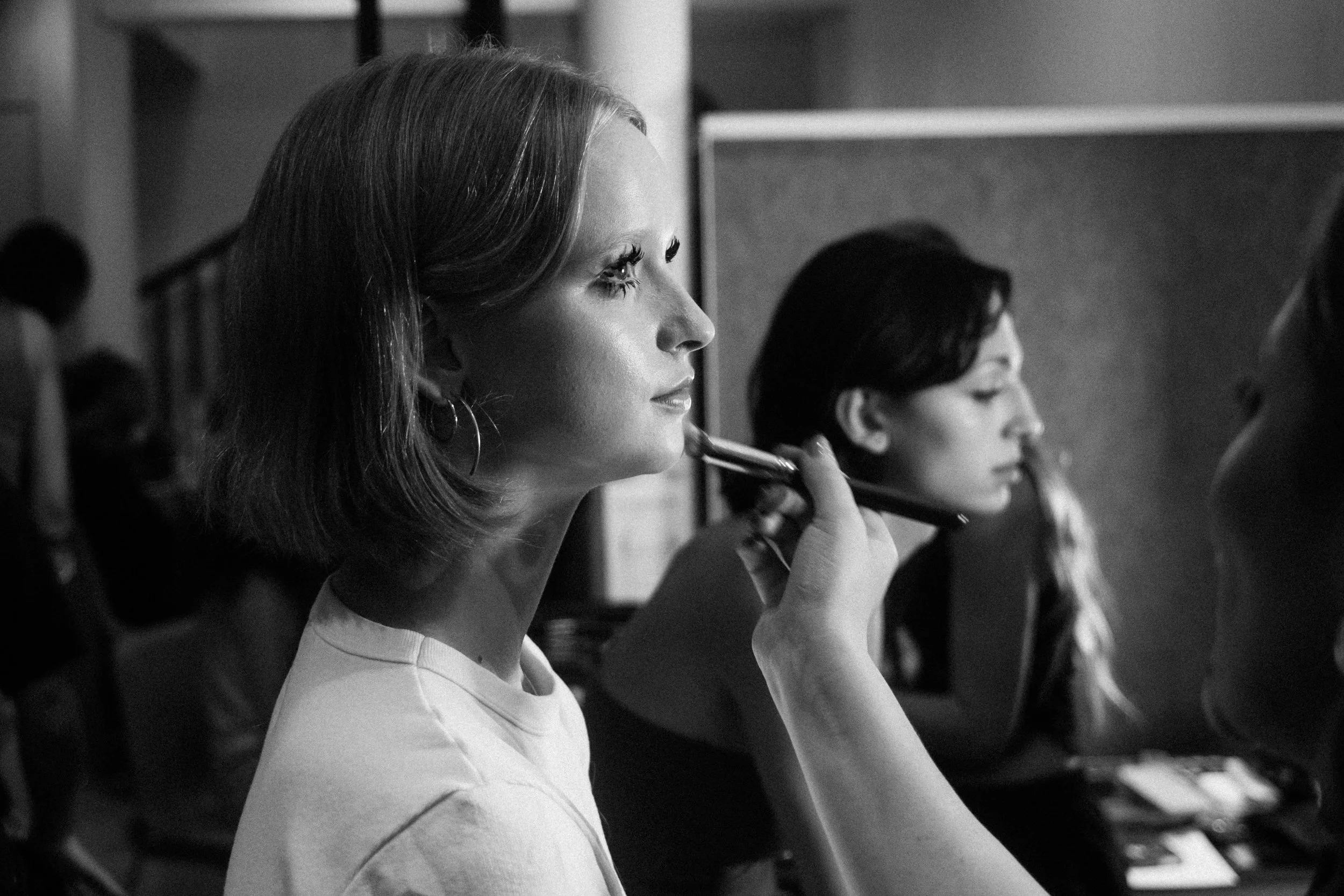
PB: Having the most wholesome and fun backstage, filled with women having a great time and living out their passions, is so meaningful to me and the reason I have the desire to do this whole effort every year.
A: How much are you still changing today? Is the collection finished when you arrive at the venue or are you someone who can still change a look ten minutes before the show?
PB: No artwork, garment or piece is every finished, at one point you just decide to stop working on it. Perfect is the enemy of good and if everything had to be perfect I wouldn’t have any collections. I am still down to add or change details the day of, but at its core the collection was at a state I am at peace with.
A: What is the hardest part of today for you personally: giving up control, making decisions constantly or simply knowing that at some point the doors open and whatever is ready has to go out?
PB: I am still at the stage where giving up control is difficult, so I still do way more running around checking in with everyone about everything than I should, so breaking away from that and putting complete trust in it all is still the hardest part for me.
A: Amsterdam is where Pauline Blind started. What does it mean to bring that world to Paris Fashion Week for the first time?
PB: It was so beautiful to see the overlap of the Amsterdam and Paris community. It made me feel very reassured in the decision of taking it all to Paris Fashion Week just a year after doing Amsterdam Fashion Week. It means the world to me that managed to show in Paris in front of such a packed room of people, I always felt like my brand was supposed to end up in Paris but now I am sure.
A: Paris also means showing the work in front of people who might have absolutely no context for Pauline Blind yet. Does that change the way you think about presenting a collection?
PB: It was very important to me that even the people that have no idea who I am, get the story for the collection within the universe of the brand. So I wanted to make sure to convey it within more than just the clothes; the set design, the soundtrack, a handout for all the guests.
A: There is something slightly insane about being this early into building a label and already showing during Paris Fashion Week. Does being here make you more aware of how far you have come or mostly of how far you still want to go?
PB: The momentum I received from the experience of making this dream come true, feels incredibly inspiring and empowering. It pushes me to keep going and making even bigger plans & dreams come true..
A: It happened!! What are you feeling right now?
PB: Overwhelmed by gratitude for the team and excitement that we made it happen. I am still in disbelief it all happened to smoothly and fast!! When a dream comes true a fantasy dies, I feel somehow reborn, the past 23 years there was only “before my PFW debut” and now there is only after.
A: Was there one moment during the show where you could actually stop thinking about what needed to happen next and look at what you had created?
PB: As soon as the models started walking the runway I was like, this is it, that’s the show, everyone is seeing the clothes right in this moments, nothing to change anymore. That’s when I could just enjoy looking around and celebrating the models walking backstage from the runway.
A: Is there anything about today that turned out completely differently from how you had imagined it?
PB: To be honest I was fully convinced the room would stay half empty. So convinced that I sat with that thought and asked myself, “And what if no one shows up, what then?” and then I thought to myself I would do it anyways, I would do it simply for the team, for ourselves to watch. In the end the room was so packed there was barely room to stand, some people even had to stand outside and watch through the open door. It was crazy! I never ever expected so many people to show up.
A: Two years ago it was Lichting. Then your own Amsterdam Fashion Week show. Now Paris. Is there a next thing you want that still feels slightly too big to say out loud? Manifest it with us…
PB: I love manifesting by speaking things into existence so let’s see… I want to present again in Paris next year, this time on the official PFW calendar. I’d love to have an official collab with adidas Originals and make some beautiful shoes and clothing. I’d love to be able to employ all my loved ones that help me so dearly and selflessly to make this all happen.
Interview by Lareen RothPhotography by Moritz Hoegemann