
Main Character, Off Camera: Jella Haase on the Beautiful Mess of Growing Up
For AFFECT's second issue, we couldn't think of a better match of everyone's growing-up story? Whether as Chantal in Fack ju Göhte or through the many unforgettable characters she's brought to life on screen, Jella has a rare ability to feel both familiar and endlessly surprising. We caught up with the actress to talk about childhood memories, the strange beauty of never really finishing the process of growing up, and the parts of ourselves we leave behind along the way. Jella opened up about finding freedom in play, navigating an industry that often demands perfection, and why she sometimes misses the directness and fearlessness of her younger self. We spoke about fame, friendship, female storytelling, and the comforting idea that maybe none of us ever truly grow up - we simply keep becoming.
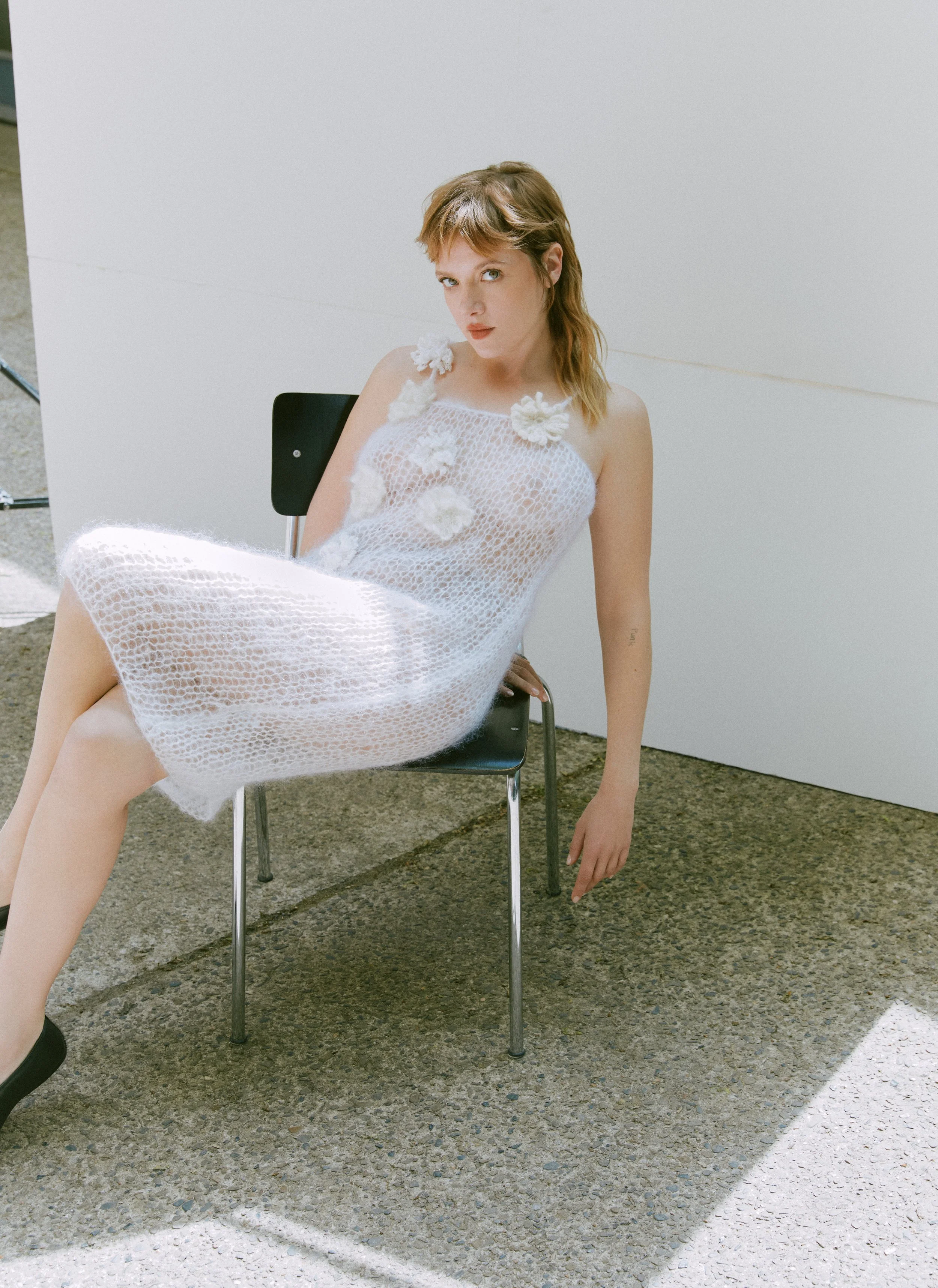
AFFECT: Who are you, what do you do, and where might people know you from?
JELLA HAASE: I'm Jella, and I'm an actress. Where people might know me from is honestly not such an easy question for me, because it actually says more about the people and their preferences than it does about my work in general. But I'll give it a try: People often tell me that they grew up with me, and that usually refers to the Fack ju Göhte trilogy. A little earlier, around 2009 and 2010, I started making feature films, and one of my first was Die Kriegerin, a neo-Nazi drama that is unfortunately frighteningly relevant again today and that people keep bringing up to me lately. Before that, I often switched sides on television and played either a perpetrator or a police trainee, a daughter, a traumatized girl, a prostitute or all of those things at once. Then I got to let loose a little on the stage and spent two years as an ensemble member at the Berlin Volksbühne while continuing to make films. 4 Kings and Kokon are two of my favorite films and both deal with the topic of this issue: growing up. Literature lovers might know me from films like Berlin Alexanderplatz or Dear Thomas. Abroad, people usually recognize me from Kleo, a Netflix series in which I play a murderous former Stasi agent. And this year, five new productions will be added through which people can get to know me all over again, which I'm really looking forward to. I'm also excited to be returning to the theater.
A: Was acting your dream job as a child?
JH: Yes, somehow it was. I think there was an irrepressible urge to play inside me from the very beginning.
A: How would you say your childhood shaped you?
JH: The loving home in which my little sister and I were allowed to enjoy every freedom laid the foundation for who I am, and I still draw from that today. The unconditional love of my parents gave me a basic trust in life. Then there were so many different influences that shaped me: Kreuzberg, Mülheim an der Ruhr, punk rock, anime, ice skating, children's theater, children's films, Cornelia Funke, car rides in a Ford Transit, birthday parties, sleepovers, mattresses on the floor, children's group meetings, pen pals, my grandparents, trips to the Baltic Sea with my grandfather, toy animals, stuffed animals, pets, traveling, fairs, "Grandpa Day," cassette tapes and somewhere in between, the freedom to play anytime and anywhere.
A: What was young Jella like?
JH: That's a lovely question. But it's also difficult because I don't know whether my memories of young Jella are entirely my own or whether they've been colored by the memories and stories of others. But maybe that doesn't matter. Off the top of my head, I'd say: Open, curious, cheeky or direct and unbiased, and perhaps a little bossy. I actually just called my sister, and this is what she said: "Open, outgoing, funny, confident, playful, with a huge imagination. A little dictator. She knew exactly how she wanted things and never questioned them. Main character energy. She could take the lead and always came up with ideas. Happy and loud, but actually very kind. Dutiful and disciplined, she would just get on with things without making a fuss.“ Maybe I should explain what she means by "little dictator“: I remember that when we played, I often wanted to be in charge and made up rules. For example, I would say a bedtime prayer, and after the final word no one was allowed to speak anymore, otherwise the prayer had to be recited all over again.
To sum it up, I'd say young Jella was very free, but also longed for rules or romanticized them. And I think I miss that directness and lack of prejudice in myself a little, that I've unlearned certain things over time. I would also distinguish between childhood Jella and teenage Jella, though. I have much less access to teenage Jella.
A: Which memory still feels like "childhood" to you today?
JH: Driving in the Ford Transit, summers in Kreuzberg, dancing in my skating dress to "King of the Bongo" playing on the radio with the windows down. Quince jelly, fresh bread rolls, and swallows at the Baltic Sea. Guinea pigs, long pajamas, and the excitement of going to bed because tomorrow is your birthday.
A: When you think about growing up, what's the first thing that comes to mind?
JH: Somehow, the answer escapes me.
A: Do you think growing up ever really ends?
JH: Yes, I think so. But I can't say when, because I've never experienced it.
A: Were you afraid of growing up?
JH: No, I don't think so.
A: Which part of you has stayed exactly the same over the years?
JH: My sense of schadenfreude and my love of having fun, being silly, and being happy.
A: Do you think we automatically lose some of our lightness as we grow up?
JH: Maybe we lose that unfiltered, playful perspective through which children see the world, because we learn to categorize everything. That's actually such a shame. The more I think about it, the more I wish I could get some of my childhood qualities back, that courage to simply approach people and not immediately judge everything.
A: What is something you appreciate much more today than you used to?
JH: I've always been surrounded by people. My mother likes to say that I always came with an entourage "Jella plus ten.“ Maybe I'm slowly learning to appreciate taking time just for myself.
A: Through Fack ju Göhte, many people came to know you as "Chantal." Did you ever feel reduced to that one role?
JH: No, not really. I actually feel like that idea is something that gets conjured up or projected onto me.
A: Do you sometimes feel that people confuse the characters you play with who you really are?
JH: Yes and no. When people only know you through your roles, I think they automatically project certain character traits of those roles onto the actor. I do that too. I watch films and think, "Oh, Brad Pitt always plays such cool guys, he must be incredibly laid-back in real life." That's how narratives are created.
A: Have there been moments when you consciously worked against expectations or against your own image?
JH: Yes, definitely. I didn't want to play another character similar to Chantal from Fack ju Göhte, because that role became so well known to a broad audience.
A: Is there a version of yourself that the public has never really seen?
JH: Yes. And I can't decide whether that's a good thing or whether I want everyone to know me exactly as I am.
A: Which version of yourself has fought the hardest to be taken seriously?
JH: I think what hurts me the most is when people deny me a certain depth, a literary quality, and a broad understanding of roles.
A: What do you learn very early about people when you grow up in this industry?
JH: That films are fleeting, but friendships last.
A: When did you first realize how harsh or superficial this industry can be?
JH: I think it starts with your first rejection and then becomes an ongoing process.
A: What does this industry do to your self-image?
JH: Phew. I think that once you reach a certain level of fame, the industry reproduces an image of you that you yourself have put out into the world, because people no longer dare to truly reflect you back to yourself. That's dangerous, that’s one side of it. On the other side, which is perhaps just as dangerous, is that it constantly makes you compare yourself to others and doubt yourself. We start believing that we have to meet certain standards and lose our own inner compass, because it's never really about our true selves, it’s about fitting into certain molds, while at the same time everyone keeps demanding authenticity. You really have to be grounded in yourself to navigate all of that well, and you need good and honest people around you. Alone, you'll be shipwrecked and sink. Harbors and lighthouses are highly recommended.
A: What is completely normalized in the industry even though it shouldn't be?
JH: That women are expected to be young, flawless, and skinny.
A: What has changed in the German film industry since you started, and what unfortunately hasn't?
JH: I think we've started talking about certain issues and we're no longer willing to accept everything. But the fact that there are still structures that protect successful people even when they behave problematically is unfortunately still part of reality.
A: What lesson has your career taught you that has nothing to do with success?
JH: Things turn out differently than you imagine, but they do work out.
A: What does success mean to you today?
JH: I'm simply grateful and aware that it's anything but a given to be able to work and realize yourself creatively.
A: What's the best advice you've ever received?
JH: Stay cool.
A: Do you ever think about who you would have become without public life and acting?
JH: I rather imagine what other things I might have done alongside acting, like studying or writing. But if I'm honest, my identity is very closely tied to my work as an actress. I don't know whether that's a good thing or a bad thing.
A: Over the years you've played so many different women. Do parts of those roles stay with you?
JH: Yes, absolutely. I really miss some of those characters.
A: What convinces you to take on a role today?
JH: A good script and something I've never done before. When someone has a vision for me that aligns with what I'm currently looking for and tells me something about life. I have to fall in love or feel the character intuitively. My agent always asks me: "Does your heart leap?"
A: Has there ever been a role that changed the way you see yourself?
JH: Yes, again and again. I learn through working on projects because they often emerge from the spirit of a particular time.
A: What kinds of stories or female characters are still missing from German cinema?
JH: I don't think we're lacking stories. We're lacking support and opportunities to fully develop and bring those stories to light. We're lacking a mindset in which women are valued equally to men and in which female narratives become part of the canon. Which brings us right back to the very root of patriarchy.
A: Do you think audiences are ready for more complicated, more uncomfortable female characters?
JH: Absolutely.
A: What would you do differently if you could start all over again?
JH: I wouldn't let myself be talked into doing things. Never.
A: Which version of yourself would your younger self admire the most today?
JH: Maybe the one flying on a dragon.
A: What advice would you give to young actors?
JH: Don't let yourself be bent out of shape. And you don't have to smile out of insecurity.
A: What would you like to say to your younger self today?
JH: I would actually just like to observe my younger self especially seventeen-year-old Jella and see whether life really was the way it feels in retrospect. Maybe I would ask her to be more conscious of the things around her and to write everything down. My youth was like one long intoxication, and I wish I remembered it better. But maybe that very blurriness is exactly as it should be. Because that's what I believe: Everything happens the way it's meant to happen.
Interview by Noemi Zak