
AFFECT caught up with actor Maximilian Mundt to talk about the freedom of creating something nobody needs to see, why figuring out a character can be easier than figuring out yourself, and how humour lets us approach the things we struggle to say out loud. Through his work on BALLZ, we got into masculinity, vulnerability and the protective layers that can keep us from the closeness we want. On growing up without having it all figured out, questioning what a desirable life is supposed to look like, and leaving enough room to change your mind.
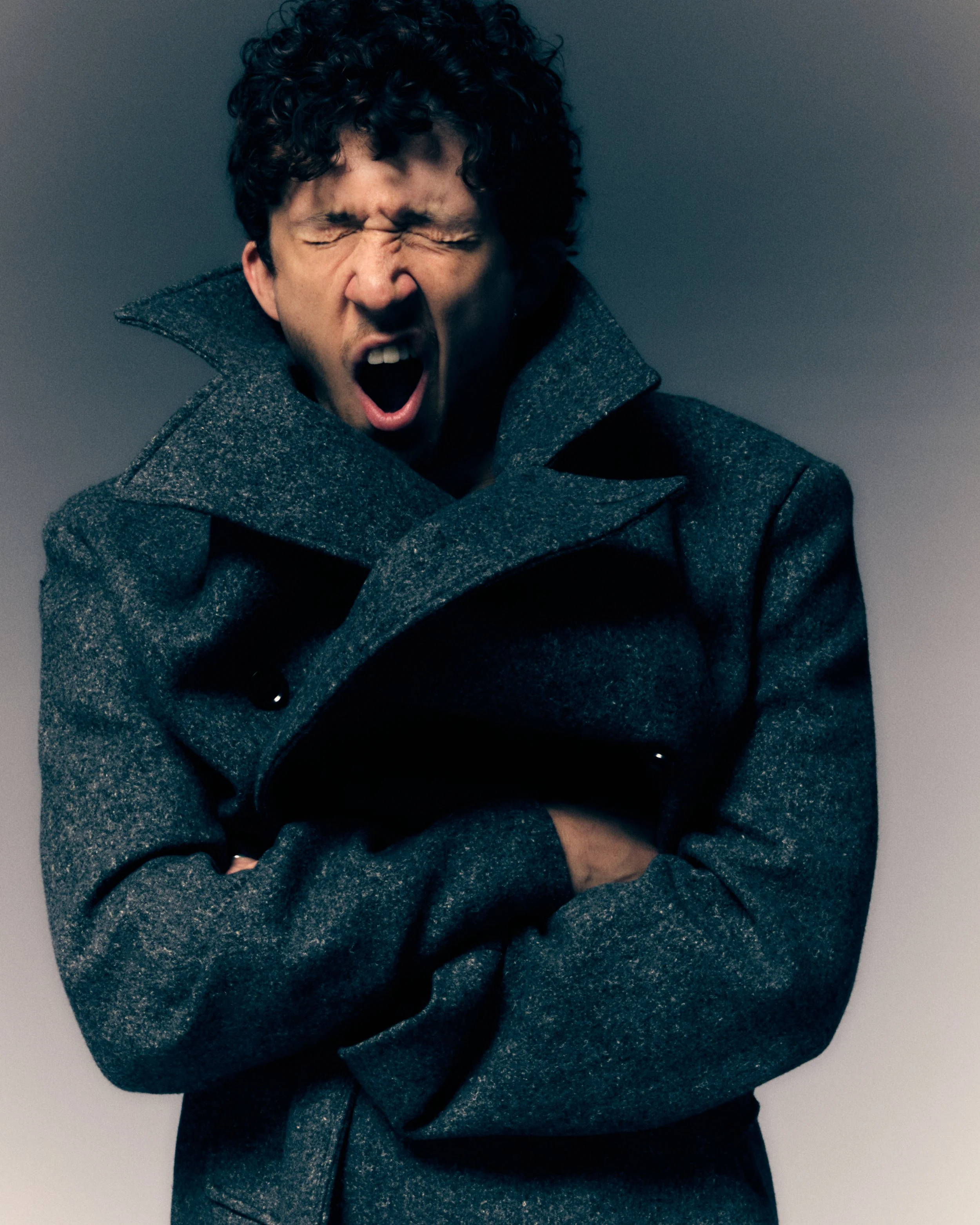
@_furis
AFFECT: If you could meet your younger self, what do you think would surprise him most about your life today?
Maximilian Mundt: Probably how much of my life is still uncertain. When you’re younger, you imagine growing up as this process of becoming a more complete person, someone who knows what he’s doing. But I think you mostly just become better at navigating the uncertainty.
A: You seem to have a lot of hands-on, analogue hobbies, from drawing and reading to building furniture. When your work is so public, do you find freedom in creating things purely for yourself?
MM: When you work in a public-facing profession, there’s always the possibility that what you do will be seen, interpreted, or evaluated by someone else. That can be exciting, but it also changes your relationship with the work. When I create something just for myself, I can just make it. It doesn’t have to represent me or communicate anything about who I am. I can build something badly, make a mistake, and fix it without anyone needing to know. There’s something very liberating about creating things that don’t need an audience.
A: When was the last time you did something for the first time and were completely terrible at it? How did that feel?
MM: I think the interesting thing about getting older is that you become more aware of how uncomfortable it is to be bad at something. When you’re a child, you’re allowed to be terrible at almost everything. Then, at some point, you start wanting to be competent before you’ve even begun. I try to remind myself that being bad at something is actually a pretty good sign. It means you’re doing something you haven’t already figured out. It’s uncomfortable, especially when your ego gets involved, but there’s also something refreshing about having no idea what you’re doing. For example, I just learned some dutch lines for an audition. Never spoke the language before which that was pretty challenging but in an exciting way. Didn’t feel my brain working that hard in a long time.
A: As an actor, you spend a lot of time figuring out what a character wants. Is that easier than knowing what you want yourself?
MM: For sure. Especially with a character I have a deadline to figure that stuff out. Latest when I‘m filming the scene. With yourself, it’s more complicated because you’re both the person asking the questions and the person who has to live with the answers. You can come up with very convincing explanations for wanting something when, in reality, you might want something entirely else the next day.
A: Do you think comedy can sometimes reveal vulnerability in a way that a more serious portrayal can’t?
MM: Absolutely. Humour can be a way of approaching something that would otherwise feel unbearable. You can make a joke about something before you’re ready to admit how much it hurts. I also think comedy is very revealing because people often lose control of their carefully constructed image when they laugh. There’s something spontaneous about it. You can prepare a serious answer, but it’s much harder to control what makes you laugh and why. And sometimes the funniest person in the room is the one who is brave enought to bring something up, everyone else is trying not to talk about.
A: Are there things your younger self wanted that you still find yourself desiring today?
MM: I think the desire to be free to explore different possibilities is something that stays with you. When you’re younger, the idea that you can become many different things can feel incredibly exciting. But having all those possibilities also means having to make decisions. And I think that can become frightening because every decision seems to close off other options. I find it interesting how we sometimes end up choosing familiar paths simply because they feel safer, even when we know there are other ways to live.
A: What would you like to be more shameless about wanting?
MM: I’d like us to be less embarrassed about wanting to live differently from what other people expect of us. That might sound simple, but I think there’s a lot of pressure to follow familiar ideas about success, relationships, and identity. Even when we know those expectations don’t necessarily make us happy, it can be difficult to step outside them. I think there should be more room to want things that don’t fit a conventional image of what a successful or desirable person is supposed to live like.
A: What kind of closeness is easiest for you, and what kind takes more courage?
MM: I think the difficult part of closeness is allowing yourself to be seen in ways you can’t entirely control. You can tell people things about yourself while still maintaining a certain distance. You can decide which parts of your identity to share and how you want them to be understood. But there’s a difference between sharing something about yourself and knowing that another person might interpret it in a way you hadn’t anticipated. I think genuine closeness requires accepting that you can’t completely control how other people see you, while still allowing them to get to know you.
A: What does masculinity mean to you?
MM: I think masculinity is something we need to keep questioning because so many of its traditional expectations can be restrictive. I grew up with certain ideas about what boys were supposed to enjoy and how they were supposed to behave. I remember feeling uncomfortable with the aggression and competitiveness that sometimes came with those expectations. As a child, I even wondered whether something was wrong with me because I didn’t fit that image. That experience made me realise how much damage gender stereotypes can do. I don’t think being a man should require you to behave in a particular way or suppress parts of yourself that don’t fit the stereotype. For me, the important thing is having the freedom to decide who you want to be without constantly measuring yourself against an image of what a man is supposed to look like.
A: Through working on BALLZ, did you find yourself thinking differently about the protective layers we build around ourselves?
MM: I was interested in BALLZ partly because it deals with a subject that many men find difficult to discuss. When I read the script, I found it quite striking how naturally the story could use humour to approach something serious. Julian is also someone who struggles to talk about what is happening to him. His situation is connected to the expectations placed on him as a man and to the difficulty of expressing vulnerability. I think that’s one of the interesting things about these protective layers. They can make you feel safer in the short term, but they can also prevent you from asking for help or talking about something that matters. Sometimes you need a situation that forces you to question the way you’ve learned to behave.
A: What happens when a man can no longer live up to his image of masculinity, whether in his own eyes or in the eyes of others?
MM: I think that can be a frightening experience because the image of masculinity a person has learned to follow can become part of their identity. If you believe that being a man means being strong, independent, and in control, then any situation that makes you feel vulnerable can seem like a personal failure. That’s part of what makes Julian’s situation interesting. He struggles not only with his diagnosis but also with the difficulty of talking about it. I think we need to question why vulnerability is so often treated as something that contradicts masculinity. If you can’t admit that you’re struggling, you end up having to deal with everything alone.
A: Do you think men are sometimes afraid that showing insecurity will make them less desirable or harder to love?
MM: Yes, I think traditional ideas about masculinity can make vulnerability feel like a weakness. From an early age, boys can learn that certain emotions are acceptable while others make them appear less masculine. I remember questioning those expectations myself as a child. I think those stereotypes can become especially damaging when they affect relationships. If a man believes that he has to appear strong and in control to be desirable, he might find it difficult to admit when he needs support. But I don’t think vulnerability should be treated as the opposite of strength. Being able to talk about something difficult can be much more constructive than pretending it isn’t happening.
A: What expectations have you had to unlearn in order to feel more at peace with yourself?
MM: I think one of the most important things is questioning the expectations attached to gender. Growing up, I sometimes felt that the things I enjoyed or the way I reacted to situations didn’t fit the image of what a boy was supposed to be. It took time to recognise that those expectations weren’t rules I had to follow. I think we all absorb ideas about how we should behave, what we should want, and what kind of people we should become. For me, questioning those expectations is a way of making more room for different ways of living. You don’t have to reject everything you’ve learned, but you should be able to decide which parts still make sense to you.
A: If your life stayed exactly as it is now for the next five years, what would you be grateful for, and what would you miss?
MM: I think I would be grateful for the opportunity to keep working on projects that make me think and that allow me to explore questions I find interesting. What I wouldn’t want is to become too comfortable with a particular version of myself. I’d like to leave room for the possibility that I might see things differently in five years. Hopefully, that would mean I’ve continued to learn something along the way.
Interview by Julia Petersen