
No Plan B: Growing Up on Stage with Hannah Schiller
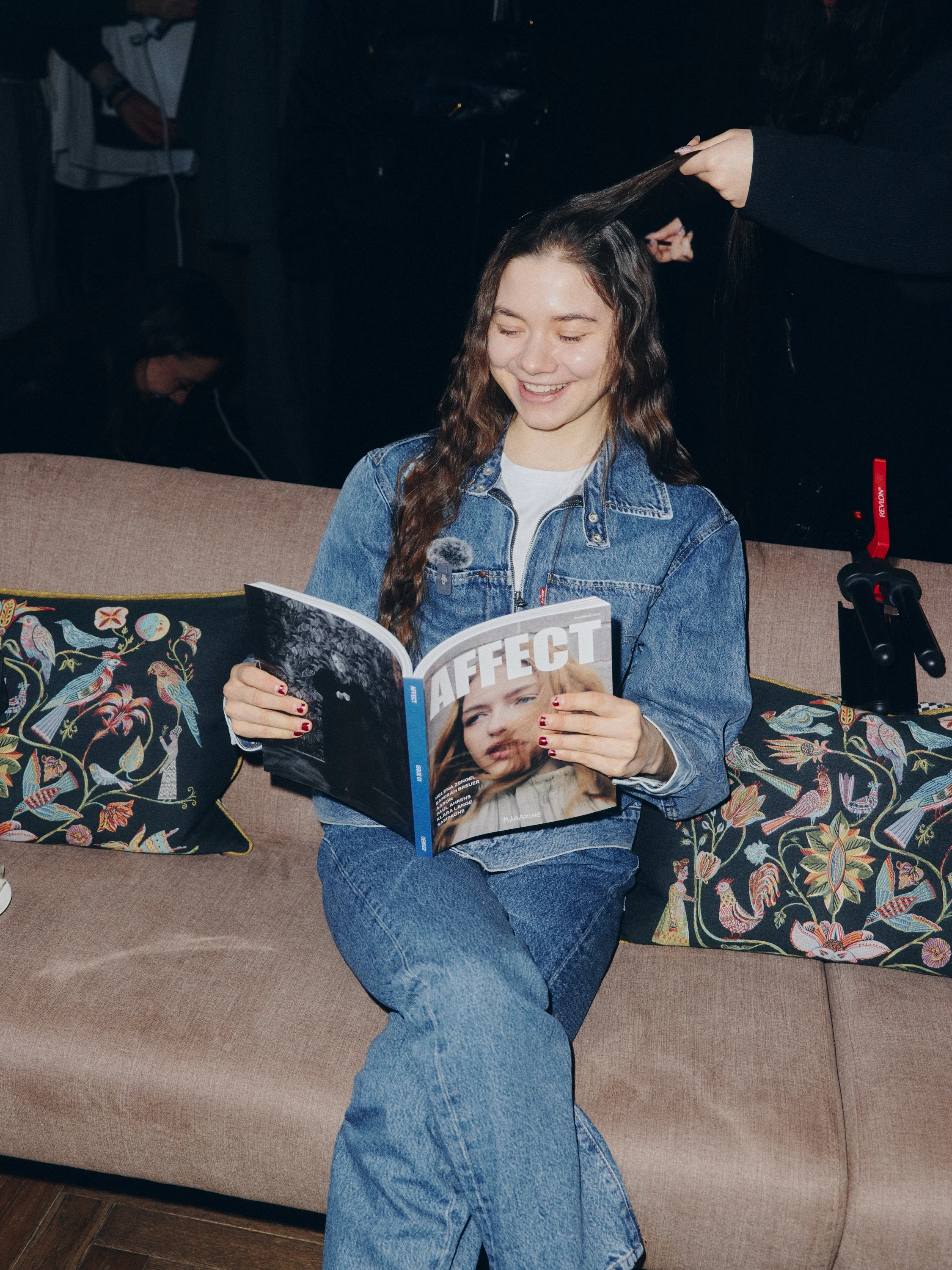
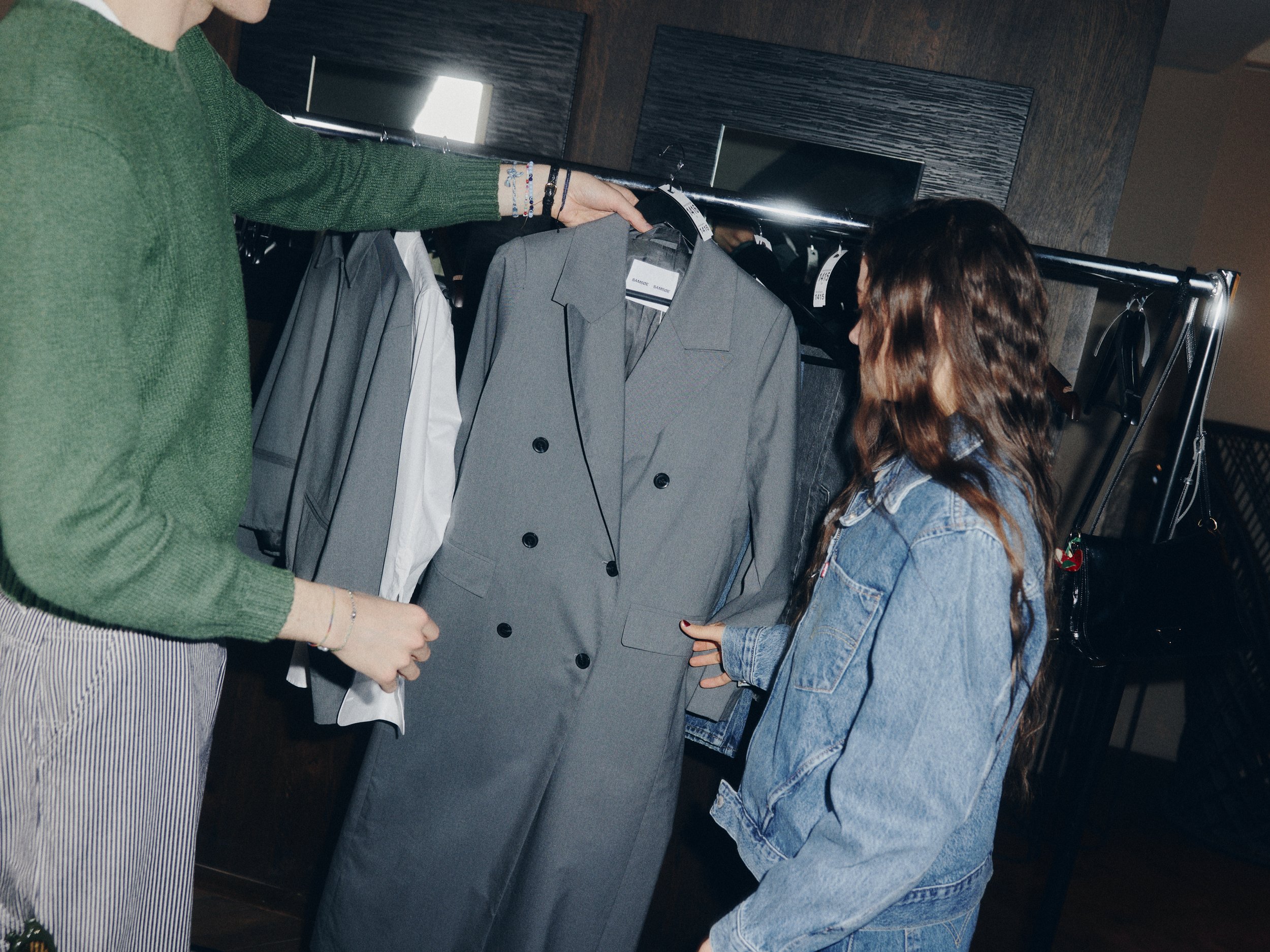
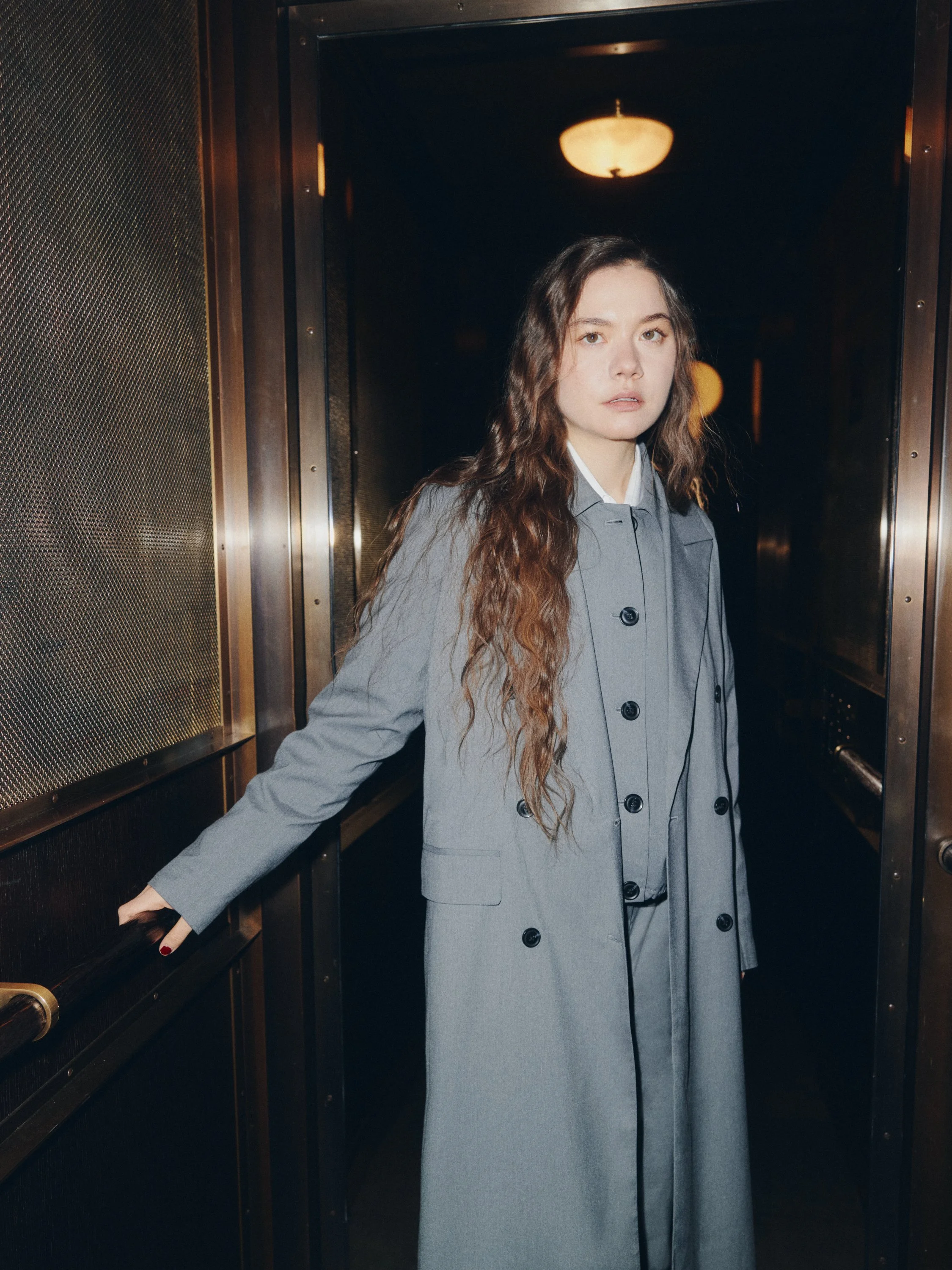
AFFECT caught up with actress Hannah Schiller at the Berlinale for the premiere of Liebhaberinnen. We spoke about growing up between opera and film sets, learning to navigate an adult industry from a young age, and her intuitive approach to acting. Hannah opened up about artistic autonomy, typecasting, and why film must dare to be political and complex. We also discussed her role as Paula and the quiet intensity of portraying fragility, strength, and contradiction on screen.
A: What was your dream job as a child?
HS: As a child I wanted to make films, and I realized fairly quickly that, as a kid, the only way you can really work in film is as an actress. And because I wanted to get to a film set as quickly as possible, and I also felt a certain flair for drama in me, I thought that might suit me, so that’s what I wanted to do. But I never thought about it like, “This is my dream job.” It just pulled me in so naturally.
A: When and how did you realize you wanted to become an actress, and how did the people around you react?
HS: I was only allowed to watch cartoons when I was little, and when I was five I saw for the first time that real people also appear on TV. And then I basically wanted to do that right away. The people around me, my parents weren’t exactly thrilled at first and didn’t really take it seriously. But when I kept insisting, my mother eventually agreed and took me to a child-acting agency, after years of pestering and persuading.
A: Was there ever a plan B?
HS: No.
A: What gave you a sense of security as a child, and what gives you security today?
HS: I think as a child what gave me security was routine and knowing what would happen next. But also my art, my drawings and the stories I came up with in my head. And I think that still gives me security today. The biggest sense of security comes from stable relationships with the people around me.
A: Who were your role models? Are there people, characters, or artists who shaped you, and why?
HS: As a child, my role model was Pippi Longstocking. And now I wouldn’t say I have a single role model. It’s more that there are people who inspire me or who I think are amazing, like Sandra Hüller as an actress, for example. But I don’t want to be like her; I just think what she does is great, and I let myself be inspired by her work and her work ethic.
A: As a teenager, were you afraid of growing up, or could you hardly wait?
HS: I think in some areas I was already very grown-up as a child and could handle that quite well. And in other areas, I was afraid of growing up. I wouldn’t say I could hardly wait. But in some ways I just did it. I mean, if you start working early, you automatically learn a certain kind of adult behavior and how to deal with adult situations.
A: You grew up around opera. What does that kind of art do to a child?
HS: For a child, it’s obviously very magical to walk around an opera house, surrounded by music, by art, by the stage. That inspired me and gave me this magical feeling in my life. At the same time, I think it also taught me a lot of discipline, simply because singing opera is such an elaborate and demanding process. It takes a lot of energy and discipline to keep going. There are countless rehearsals, you have to learn a lot. And there was also this expectation that it had to be good, because it wasn’t some little children’s theatre piece, it was the big stage. And if you sing solo there, they expect you to do it perfectly and not screech out wrong notes. So I think it taught me a lot of discipline. And the pressure to perform was intense, which I didn’t necessarily think was bad, but I do think it affected me over time, without me fully realizing it.
A: What is it like to grow up in this industry as a child?
HS: As a child you’re basically part of the process without really shaping it actively. You mostly do what other people tell you. And it took a while, as I got older, until I realized: okay, I can also say, I don’t want this or I do want this, or I want us to play it this way, or I have this and that idea in my head. That took some time.
I think just like with opera, there’s a certain kind of magic that comes from the creativity you’re surrounded by. But at the same time it’s a setting of adults. That means you’re expected to act like an adult. You can’t suddenly say, “I don’t feel like it anymore.” You have to push through, and shooting days can be very long. Even if children are only allowed to work certain hours, it’s still exhausting.
And when you go back to your life after work, it’s hard to suddenly be a child again and have to do everything your mom says when on set someone might be carrying your umbrella for you, and so on. I think I handled it quite well, but I do think it’s a challenge that many child actors face.
A: How does it change a person when play suddenly becomes a job?
HS: I think a childlike side always stays in you, which is really beautiful if you’re aware of it and can use it in a controlled way. But I think for many people it can also be overwhelming. For me it’s okay, because I also have other art forms through which I can express myself. But I do think that, in general, acting can be a bit addictive. Especially when you feel like: okay, in this scene everything is possible, I can try anything, I can enter this connection with the other actors, that’s amazing. And it gives you an adrenaline rush, and you can miss it when it’s not there.
A: Was there a particular moment on set that changed you or your perspective on acting or the industry?
HS: What changed things for me was seeing how some had a hard time subordinating themselves to the team or seeing themselves as part of the team. Sometimes actors get thrown on a set and everything is ready for them. I love the Team Work aspect of filmmaking and I want to see myself as a member of the team our job is one of many on set and doesn’t make us better than anyone else, even if people sometimes admire us for what we do.
A: When did you first feel like you were becoming an adult and being perceived as an adult by others in the industry?
HS: On the set of Reset, the series where Katja Riemann played my mother. That was the set where I really learned to set boundaries and to voice my opinion, about conflicts on set, in front of or behind the camera, and about scenes and creative decisions and processes. And that’s when I realized: if you communicate with adults, you’re also perceived as an adult. I had communicated with adults before, too, but I hadn’t claimed that kind of power for myself. And that’s also something you have to be careful with, so you don’t end up misusing it.
A: You draw incredibly well. What does drawing give you that acting can’t?
HS: As mentioned before acting is teamwork on set. And in a way you also have to listen to what a director says, or what editors or producers want, how you should play it, what the project should look like, what the costume should look like,etc. With drawing, I can be very autonomous and decide for myself what the final result should look like. And I find that really enriching, because it very concretely reflects my own view of the world and my inner emotional world.
A: Do you have a ritual that helps you get into a role, or come out of it again?
HS: No, not really. I’m also not doing method acting in the sense that I stay in character between takes. When we’re shooting the scenes, then I’m in the role. And there are very different things that give me that feeling of being connected to the role. And when we’re not shooting anymore, then I’m out of it again. So I don’t really have a ritual, I just draw it out of myself.
A: How do you deal with roles that challenge you emotionally or push you to your limits?
HS: I’m very careful to make sure I really step out of the role again and don’t take it home with me too much. I spend time with my friends and with completely different things that have nothing to do with acting, because I don’t want it to be the only thing I’m occupied with mentally, psychologically, or physically. And sometimes I also talk about it if it weighs on me. But I think the key to a certain peace of mind here is having a life outside of set that feels fulfilling. And that has a lot to do with social contacts and, in general, the structure you build around yourself.
A: When you act, do you rely more on intuition, or do you follow a clear method?
HS: I work very intuitively. I don’t have a clear method. But if I feel like I need that for a project, or that I’d like another perspective, from someone trained, with a trained eye, then I do that with my acting coach, Frank Betzelt. And he can always give me really interesting input.
A: Are there certain role types you unconsciously fall into? How do you decide today whether to accept or reject a role?
HS: I think “falling into it” and “unconsciously” would mean it comes from me. But I think these are things that come more from the outside from productions, editors, or casting agents, because they see something in me. I do look younger than I am. And that’s why people think I can’t play older roles. And then I have to consciously accept roles that counteract that. Not that I choose roles only based on age, but I do try to take roles that keep me from getting stuck in that.
A: Which female characters do you feel are missing in German-speaking cinema? Where do you still see room for improvement in the industry?
HS: Basically, the film industry is a business. And I think you do have to show audiences what they want to see. But of course, you can’t really find out whether audiences want to see something if you just never do it. I’d love it if there were more experimentation—so that older women, too, have bigger, more complex roles and their own stories get told, and they’re not just side characters.
A: Many of your roles carry a certain fragility. How do you personally define strength, and has your understanding of it changed over the course of your career?
HS: For me personally, strength is loyalty, authenticity, and being honest with yourself. Of course, also with others, but especially with yourself. I think that’s strength. And I don’t think my understanding of it has really changed over the course of my career. I just wasn’t as consciously aware of it before, because I didn’t think about it that much. But I think those are values I’ve considered especially important for as long as I can remember.
A: If you could write a role for yourself, what would your perfect role look like?
HS: It always depends on the framework in which the role is embedded, whether it’s a good script, whether I like and respect the people involved in the project, whether I find the setting interesting. That’s why I can’t generally say which kind of role would interest me and which wouldn’t. But fundamentally, I would love to play a character set in a historical context, perhaps even someone who actually existed.
A: What change would you most like to see for women on set?
HS: In general, for women, but really for all creatives in this industry,I would like creative decisions to lie more strongly with the creatives themselves again. Creativity should matter more than commercial logic. Decisions shouldn’t primarily be made by streamers or broadcasters, but by the people who are telling the stories. In my view, actresses, writers, and directors should be given more trust and creative freedom, and be less defined by purely market-driven guidelines. When creativity is mainly steered by algorithms, target group analyses, or network strategies, we lose diversity, risk-taking, and with that, genuine female perspectives.
A: Do you believe that film can change society? And if so, what kinds of stories should be told right now?
HS: I definitely believe that film can change society. Language shapes thought, so film can shift perception, create empathy, and open up new frameworks of thinking. Often, it doesn’t necessarily change opinions, but rather what we consider narratable, feelable, or even “normal” in the first place.I think we live in a time that loves quick judgments. People are “canceled” or condemned very quickly based on fragments of information someone picked up somewhere. Film can counter that by telling stories about contradictory characters and showing the ambivalence of life and perhaps simply letting that ambivalence stand.
I also think it’s important to tell stories about power, dependency, and quiet forms of violence. By that I mean emotional dependencies, structural inequalities, dynamics in which no one is “the monster.” That’s important because such stories sharpen our perception of things we often overlook or normalize in everyday life. In connection with the question of what I wish for women, I also believe we don’t necessarily need “strong female characters,” but rather women who are ambivalent, tired, selfish, tender, contradictory, women who aren’t defined by their function for others. Women who age, fail, desire, gain or lose power. Telling those stories doesn’t just change the images we see on screen, but also our self-images. I think it’s always important to tell stories that take risks. We need films that don’t have to please everyone, that don’t follow an algorithm, that dare something — even at the risk of failing. Cultural stagnation often feels like it’s “working”, until you realize it’s empty. And yes, I don’t think you need to run around with a raised finger and a blackboard to point out political and social issues. The medium of film offers so many ways to make these things visible and tangible. We should use that.
A: In times of social tension: Can film even afford to NOT be political?
HS: I don’t believe film can really afford to be apolitical in times of social tension. The decision about what is told and what is not, is already political. Even escapism is a stance. Film often only appears apolitical when it doesn’t question existing conditions. But that, too, is a statement. At the same time, “political” doesn’t mean overt activism or thesis-driven filmmaking to me. On the contrary: film becomes powerful when it doesn’t explain, but makes things experiential, when it shows how social tensions settle into bodies, relationships, and biographies.
A: What attracted you most to the role of Paula?
HS: First of all, I really admire Elfriede Jelinek, who wrote the novel Women as Lovers (“Die Liebhaberinnen”), so I was already very interested in the project because of that. Then I met the director Caroline Kox for the casting and later for a conversation, and I found her thoughts and her approach to the project and the creative process very exciting and appealing. I find Paula fascinating character to play and understand because she moves within a system of expectations, economic pressure, and emotional dependency, trying to survive without sinking without necessarily having the right words or tools to do so. Her decisions are often contradictory, sometimes painful, also for others, but they arise from a very real lack of alternatives. That makes her deeply human, I think.
I was also interested in how much inner movement and hope can exist in a character who outwardly has so little room to act. And within the context of the whole project, I was drawn to how violence, longing, and hope don’t appear as grand drama, but rather quietly inscribe themselves into relationships. Paula is certainly not a heroine, but she’s not a victim in the classical sense either, she’s a young woman trying to save something for herself within very narrow limits.
A: Looking at your career so far, what are you particularly proud of?
HS: I’m not sure what I would define as milestones in my career, but I know that I’m fundamentally very proud to be working so consistently as an actress, because I know that’s not something to be taken for granted and is also something very fragile. I’m also very proud to be represented in Germany by the agency Players — I think it’s a great agency — and internationally by the Independent Talent Group. Those are certainly milestones, because they shape my standing in the industry and my work in a lasting way.
It was also a very proud moment for me when I shot a film in the U.S. and the first another one in London. I think first times are often the moments you’re most proud of in retrospect.
A: What does success mean to you?
HS: I think what feels like success and what other people would evaluate as success from the outside are two very different things. Professionally, success for me means being able to work on projects that I stand behind artistically and in terms of content, together with people who inspire me and whom I respect. So professional success, for me, is finding creative fulfillment in my work.
A: How does this Berlinale feel compared to your very first Berlinale?
HS: At my first Berlinale, everything was new.That’s not the case anymore. Now it feels much more familiar. I know the places, the people, the events, it feels more like meeting old acquaintances again.
A: If you could ask your future self one question and receive an answer immediately, what would it be?
HS: Honestly, I can’t think of a question, because I quite like not knowing the future. Maybe it would be interesting to hear that my future self is proud of my present self. But even that,I don’t necessarily need to know. I like that the future is open. Otherwise, I couldn’t do this profession.
A: When you see yourself in five years, what is your dream for the future, personally or professionally?
HS: I would really like to deepen the collaboration with my English agent and work in London again. I’d also love to shoot in America again. In general, I find it exciting to work abroad and in different languages. And there are a number of people, also in Germany, that I would very much like to work with — or work with again.
A: What would you say to your younger self, who had just started acting?
HS: Don’t give up! Keep going, it’s worth it.
A:When you think of your younger self: What would you admire about her today?
HS: Her naivety and the excitement with which I looked at the profession and the industry. I think I’ve become quite disillusioned by now. That has its good sides, but sometimes I also find it a bit sad.
by Noémi Zak
PHOTOGRAPHY BY samuel smelty