The Making Of : Heimathafen a Tribute To Karl Lagerfeld
AFFECT is delighted to present Heimathafen a tribute to Karl Lagerfeld. During her time at CHANEL, Hamburg-born designer and art director Anna Marleen Kutsch began shaping the first ideas for a tribute collection in the fall of 2024. She found herself drawn to Karl Lagerfeld’s way of treating fashion as a narrative medium, garments not as mere objects, but as vessels that carry histories, hesitations, and flashes of courage. Equally moving for her was his enduring connection to Hamburg, the city that launched his journey into the world of fashion. Anna shares this deep bond with her own Heimathafen, feeling both anchored by it and quietly urged toward new horizons. This gentle tension, between rootedness and departure, forms the pulse of her collection.
Here are her own thoughts on the project:
In May of this year, a very special project took shape.
A homage to Karl Lagerfeld.
At the iconic Villa Jako, his former residence.
An editorial – captured in pure analog photography and film.
Brought to life with the energy of a remarkable team of young creatives.
On the following pages, we invite you to discover the creation of “Heimathafen”
– from the first spark of an idea, through production, to its final realization.
Creation & development
During her time at Chanel, Anna Marleen Kutsch – a young designer and art director from Hamburg – began developing the first ideas for a tribute collection in the fall of 2024. Fascinated by Karl Lagerfeld’s ability to use fashion as a narrative form, and deeply moved by his strong connection to his hometown of Hamburg, the city from which his journey into the world of fashion began. Anna shares this profound bond with Hamburg, her Heimathafen, while at the same time feeling the urge to set out for new horizons.
Inspired by the Métiers d’Art Show 2017/18, a transitional collection was created that captures the raw elegance of Hamburg while reinterpreting Karl Lagerfeld’s iconic style codes for Chanel. Hanseatic tradition intertwined with luxurious craftsmanship.
Along this journey, the first ideas for what later became the editorial also began to take shape. Niklas Reinfelder – a young photographer and creative director from Munich – joined the concept. The prior collaboration between Anna and Niklas laid the foundation for their creative exchange and the pursuit of a shared vision, despite the geographical distance.
Production & shooting
Very soon, one thing became clear, Villa Jako, Karl Lagerfeld’s former home, was to serve as the setting for both the editorial and the accompanying film. No other place embodies Lagerfeld’s deep connection to Hamburg quite like it. And indeed, we succeeded in convincing the new owner of Villa Jako to support our project.
Together with Felix Finken, DoP and producer of the project, and Jacob Herrmann service producer from Hamburg, we assembled a remarkable team and, guided by a clear vision, set out to find the right cast. Hundreds of hours later, the final looks, a precise visual concept, and a concrete list of motifs and shots had taken shape.
By mid-May, the project was finally brought to life, on a day that was, unusually for Hamburg, both sunny and warm. Working entirely on analog allowed us to focus on the essentials, while the team from Munich and Hamburg collaborated seamlessly, like clockwork.
The large- and medium-format analog films were developed and scanned by hand, while Studio L’Equipe processed the 16mm footage. This was followed by the detailed process of selection and editing, with an original piece of music composed especially for the film.
And now, almost a year after Anna’s very first idea – the final editorial has come to life: 28 photographs accompanied by a 2-minute film.
Concept & Collection
Karl Lagerfeld was not only a visionary of fashion but also a storyteller who infused clothing with emotions through iconic stagings. His shows for Chanel were far more than presentations of new collections – they were events that placed culture, architecture, history, and personal influences into a unique context. The Métiers d’Art Show 2017 in Hamburg is a perfect example of Lagerfeld’s ability to connect fashion with a strong narrative and visual concept.
“Heimathafen” is a homage to Karl Lagerfeld and his ability to use fashion as a form of storytelling. Inspired by his Métiers d’Art Show 2017/18 in Hamburg, the editorial captures the spirit of this city – a place of departure, where past and future meet. The port of Hamburg symbolizes this feeling: a gateway to the world that unites home and wanderlust.
Like Karl, who began his journey into the world of fashion from here, I too feel a deep connection to this city. Hamburg is my “Heimathafen” – a place that anchors me while also giving me the possibility to set off in new directions. This duality is the core of “Heimathafen”: the moment between staying and moving on, between tradition and new beginnings.
With this project, I tell a visual story of identity, longing, and movement. The anchor serves as a symbol for the balance between stability and departure – a symbol that unites Hamburg, Lagerfeld’s journey, and my own creative development. “Heimathafen” is a bow to Karl Lagerfeld, to Hamburg, and to the idea that fashion is not just clothing but an expression of origin and future at the same time.
The connection to Karl Lagerfeld and Chanel.
Lagerfeld’s Métiers d’Art Show 2017 in the Hamburg Elbphilharmonie impressively demonstrated how he intertwined fashion, atmosphere, and identity. Hamburg was not used merely as a backdrop but as a narrative foundation reflected in materials, cuts, and details. This is precisely where “Heimathafen” begins: the collection continues Lagerfeld’s idea by translating Hanseatic and maritime elements into a luxurious, Chanel-inspired formal language.
Elements & meaning.
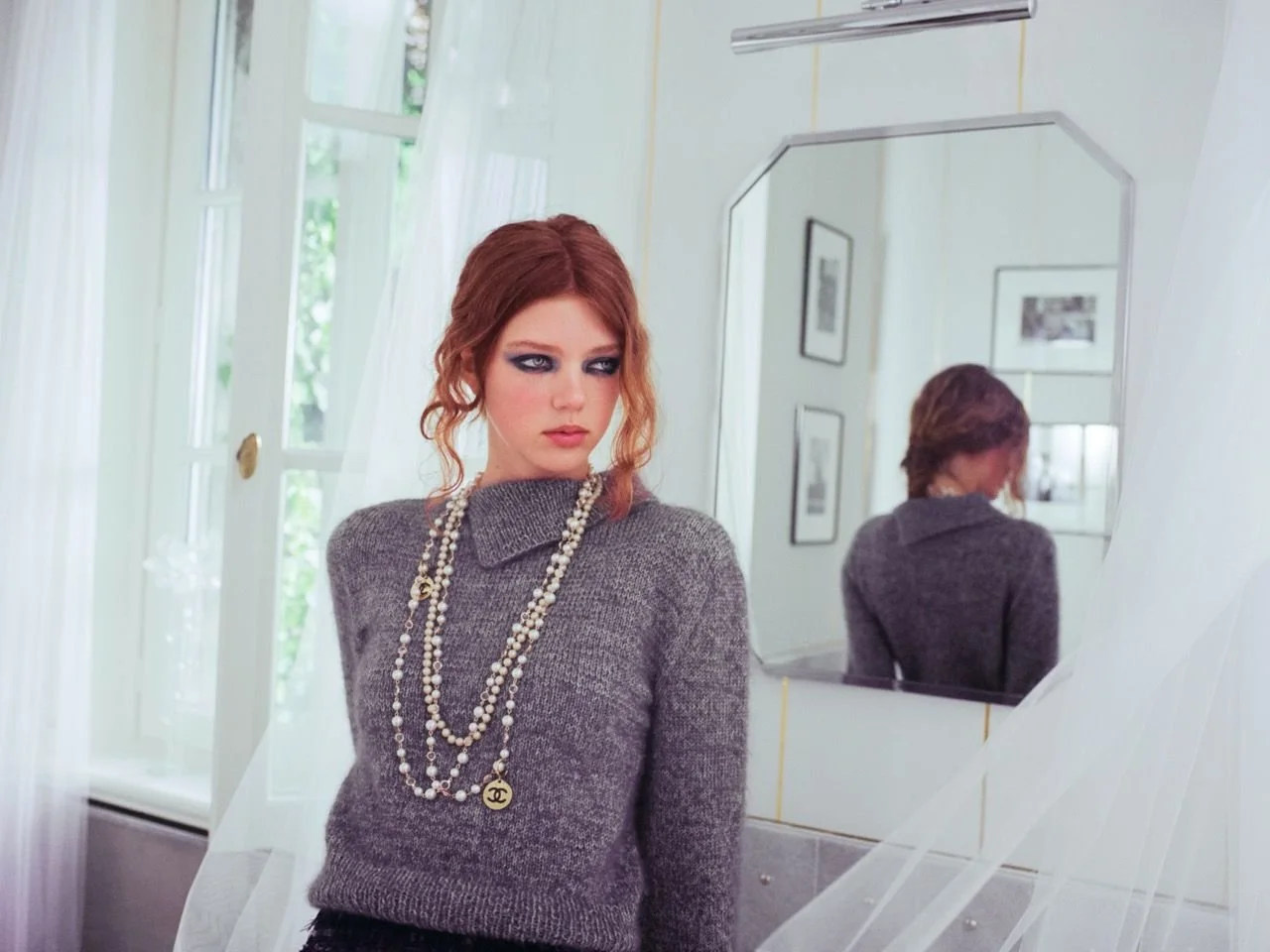
The transitional collection captures the raw elegance of Hamburg and reinterprets Karl Lagerfeld’s iconic style codes for Chanel. The looks combine Hanseatic tradition with luxurious craftsmanship. Classic maritime elements such as officer’s jackets, gold buttons, sailor collars, and sailor’s knots are presented in a modern way. Knitwear, bouclé, and fine wool fabrics reflect the northern German coolness, while muted tones – navy, shades of grey, Bordeaux, and warm brown tones – capture the atmosphere of the port. Silhouettes show structure and movement, sometimes tightly fitted, sometimes loosely flowing, to convey a sense of departure and belonging at once. Fine maritime details, references to uniforms, and weatherproof accents combine functionality with Chanel’s unmistakable aesthetic.
The symbolism of Heimathafen.
With “Heimathafen,” I tell my own visual story. This collection is not only my creative dialogue with the city, with fashion, and with the idea that clothing is more than a statement – it is an expression of identity, past, and future at the same time. Yet despite my personal signature, it remains a homage to Karl Lagerfeld, to Hamburg, and to the idea that fashion remains a form of storytelling across generations.The collection unites my memories, my inspirations, and my creative signature. The anchor as a symbol stands for the balance between rootedness and freedom – exactly what Hamburg means to me.
Design idea & inspiration
The transitional collection “Heimathafen” captures the raw elegance of Hamburg and reinterprets Karl Lagerfeld’s iconic Chanel codes. It is a homage to the Métiers d’Art Show 2017/18 in Hamburg and at the same time a personal exploration of the house’s DNA – shaped by my experiences and impressions during my internship at Chanel. There, I met people who kept Lagerfeld’s spirit alive – through an effortless combination of historical pieces and contemporary design. This balance between tradition and innovation fascinated me deeply. Although Lagerfeld is no longer here, his influence remains tangible: in the distinctive tweed silhouette, the elegant strictness of black-and-white contrasts, or in an accentuated collar.
“Heimathafen” takes up this interplay, between Hanseatic aesthetics and luxurious Chanel design language. Maritime elements such as sailor collars, rope details, and structured coats with references to dockworkers meet fine, tailored tweeds. Material mixes and precise cuts pay tribute to Lagerfeld’s signature. As a Hamburg native, I feel a special connection to Lagerfeld. His biography shows that origin and internationality are not contradictions but creative sources. “Heimathafen” continues this idea: a collection for women who appreciate tradition yet confidently look forward – independent, clear, and timelessly elegant.
It was only through my internship at Chanel that I began to truly understand Lagerfeld’s work. Before that, he was primarily an iconic figure to me. But behind this façade lay an extraordinary storyteller who understood fashion as a form of narration, full of history, vision, and identity. This realization now shapes my collection: “Heimathafen” does not merely speak through clothing, but creates a world.
Editorial storytelling: Villa Jako
The Elbe as a silent companion.
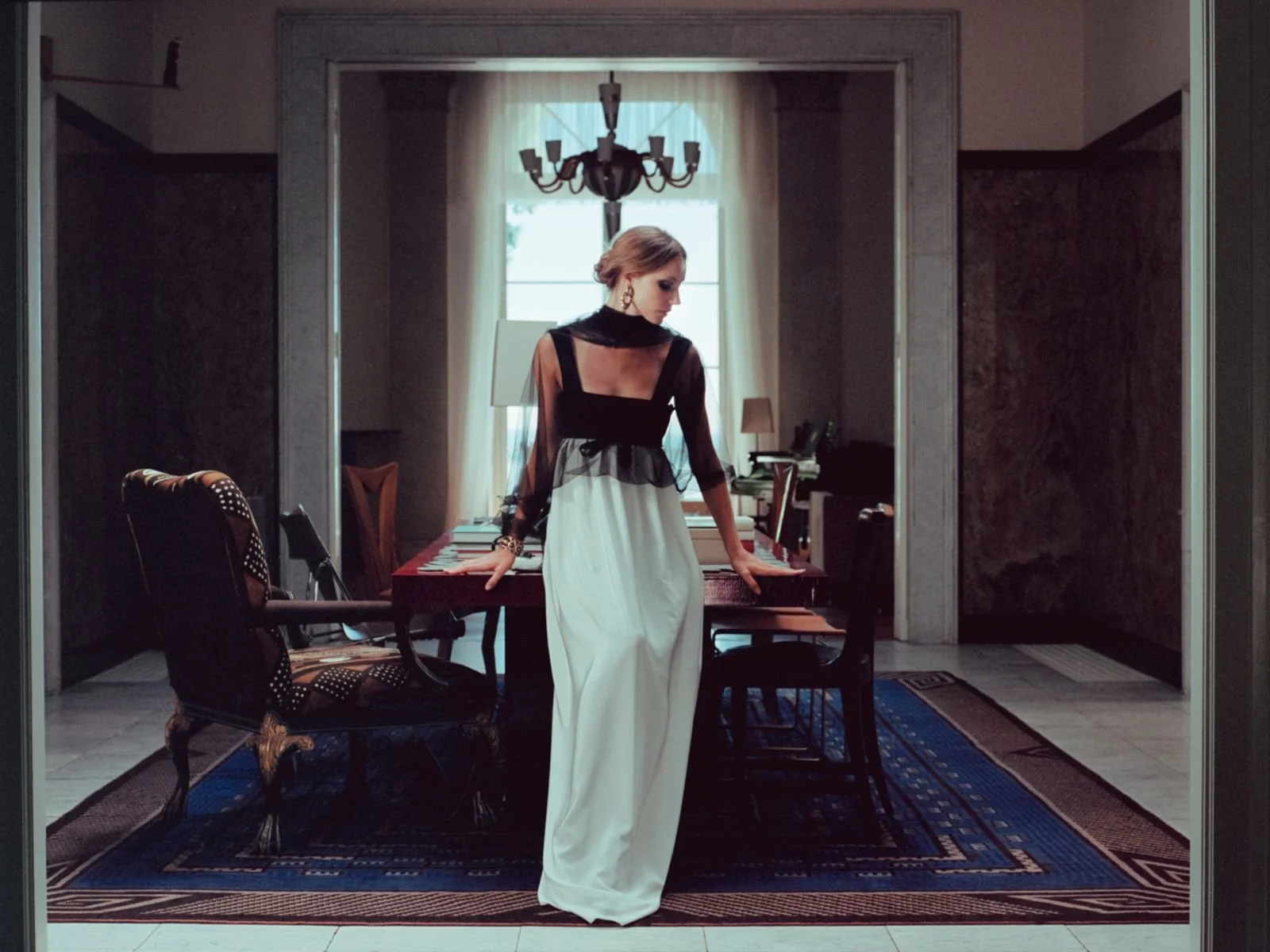
The Elbe is not a place of return, but a constant companion, the connection, the river that never stands still. Hamburg, as a gateway to the world, becomes a metropolis of constant departure and transformation. The woman in the editorial is part of this river, this movement. She does not look back, but forward. Yet she is not alone. Beside her stands a second woman – calm, grounded, with a gaze that already knows the breadth of the world. She is not there to lead, but to support. A quiet figure of strength, like a lighthouse that offers orientation without moving itself. Her presence gives the scene a second layer, a feeling of grounding and direction.
Narrative thread.
The departure, she enters Villa Jako, her “Heimathafen,” but not with the intention of staying. The place is not her destination, but her starting point. Here she is not searching for the past, but for the next stage of her journey. Her clothing is a reflection of the city: Hanseatic, elegant, functional, yet clearly connected to global style. She is not nostalgic, but bold and confident.
The second woman, not older, but more mature, is already rooted in life. She is part of the place, almost its embodiment. In her posture lies calm; in her clothing, depth: clear fabrics, timeless silhouettes. While one leaves, the other stays – not because she must, but because she chooses to. Her role is not to accompany, but to strengthen. Between the two women exists a quiet understanding. A passing-on, not a lesson. A widening of space, not a limitation.
The Elbe as companion, The Elbe is her silent companion, a presence that never leaves her. The river is like her inner calm, a constant. Her movements are steady but assured. She steps onto the terrace of the villa, which rises high above the water. The view of the Elbe reveals the continuous flow, the exchange between the city and the world. The Elbe always carries something with it; it is both boundary and path.
The second woman also looks at the Elbe, but differently. For her, it is a mirror of memories; for the other, a promise. This quiet shared moment carries strength. Hamburg as a gateway to the world.
She looks at the water and sees not only the river, but the endless possibilities that Hamburg and the world offer her. Her clothing reflects this journey – from the classic codes of Hamburg, emphasized through maritime details and precise cuts, to the modern accents that symbolize global connection and evolution. The determination.
She does not stay in the villa but sets out. The place was never the destination but the starting point. Her steps are firm, as if moving with the Elbe. Her path leads forward, without doubt, yet with the calm clarity the river gives her. The Elbe, always accompanying her, becomes a symbol of the continuous flow of life that never leaves her.
The second woman remains – but her role is not one of staying behind, but one of enabling. She stands at the edge of movement, yet she is part of the story. Her calm gives strength; her presence is a quiet impulse toward self-determination.
Visual implementation.
Villa Jako as a harbor: The architecture of the villa is shown as a stable anchor, while the movement of the younger model in contrast symbolizes continuous development. She is present but not confined – Hamburg is a gateway, not an end.
The Elbe as an accompanying element: the view of the water, the soft ripples, the opening horizons. The movement of the water is always present – sometimes as a reflection, sometimes as wind drifting across the surface, moving the fabrics of her outfit.
The second figure: In her stillness, she becomes a pillar. She stands within the space, the architecture, on the threshold. Her clothing is clear, almost sculptural. Not made for movement, but for presence – a calm counterpoint to the younger woman’s gesture of departure.
Colors & textures: The collection uses deep blue maritime tones as well as bright accents that symbolize departure and clarity. Fabrics that move like waves, and clear, precise cuts that reflect both classical elegance and modernity.
Movement & stillness: Her steps are calm and confident, never rushed. She steps forward, not with hesitation but with resolve. The second woman remains – in posture, in gaze, in her role. Both women embody different facets of the same moment: one leaves because she chooses to – the other stays so that it becomes possible.
Key image with homage.
The model stands with her back to the camera; the white collar accent and the clear, modern lines of the collection stand out. She looks toward the Elbe, her gaze forward, while the reflection on the water symbolizes Lagerfeld’s influence in the fashion world – like a silent companion who always remains.
Extended homage elements.
The eye for detail and structure, Karl Lagerfeld was known for his love of clear lines, precision, and devotion to detail. The design of the collection is inspired by strong, structured cuts and geometric, precise elements reminiscent of Lagerfeld’s working style. The model draws attention to certain details in the collection, a Chanel tweed pattern referencing the brand’s history, or maritime elements (such as anchors or wave forms) that evoke both Lagerfeld’s elegant minimalism and his love of detail.
The white collar as a hint: Lagerfeld was famous for his strict white collar and iconic appearance. A subtle but strong reference: a white collar as a detail on an otherwise modern, clean outfit. This is a subtle homage to Lagerfeld’s approach to fashion – an element of the past reinterpreted through the lens of the present.
Symbolism of creativity, Lagerfeld often said that fashion is a universal language that crosses cultural boundaries. The image of the model standing on the terrace overlooking the Elbe symbolizes this openness and the connection to the world that Lagerfeld emphasized throughout his career. The vastness of the Elbe becomes a metaphor for the boundless creativity that always drove him, just as Hamburg was a gateway to the world, Lagerfeld himself was a “gateway” to the international fashion world.
Elegance in departure, Lagerfeld always combined elegance with modernity. The anchor as a sign of stability and clarity, two values that Lagerfeld embodied in his work.