
Studio Visit With Larsen Jewelry: Why Jewelry Should Feel a Little Alive
AFFECT caught up with Emil Larsen, the Berlin-based jewelry designer behind Larsen Jewelry, whose pieces exist somewhere between raw Nordic textures and the restless energy of Berlin. We spoke about growing up, sentimentality, and the strange emotional weight jewelry can carry. Between pearl rings, futuristic furniture references, Brad Pitt and late-night sketches written half asleep in his notes app, Emil reflects on why imperfection often feels more alive than perfection itself. The conversation drifts between humor, philosophy, and tiny details that suddenly become deeply meaningful, much like his jewelry.
AFFECT: Who are you, what do you do, and where might people know you from?
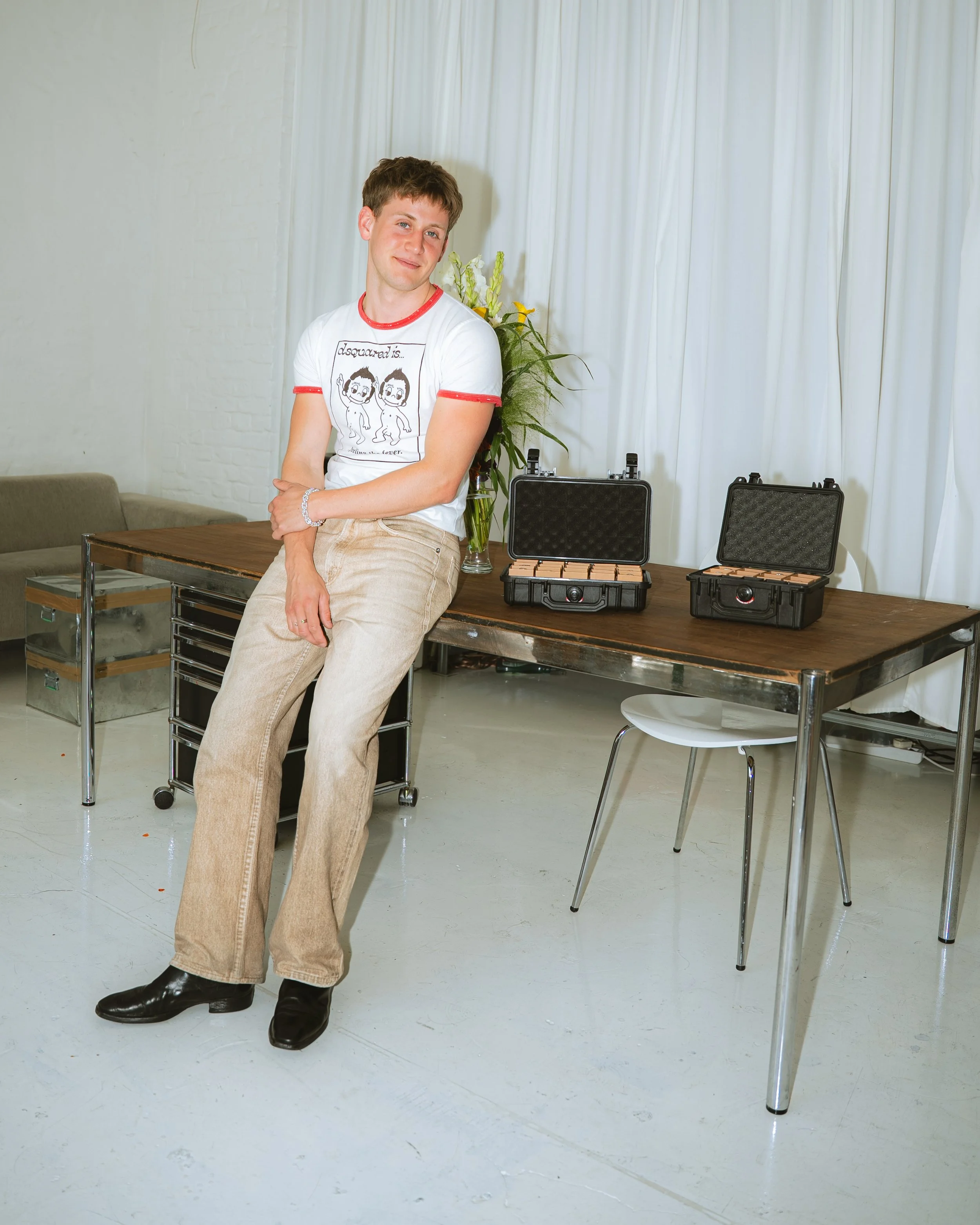
EMIL LARSEN: I’m Emil, 27 years old, and I’m from Berlin. I design and create jewelry under the name Larsen Jewelry. Some people might know my work through social media.
A: If you had to describe Larsen Jewelry in three words, what would they be?
E: Sparkling, colorful, stones. “Blitzeblanke bunte Steine.” A German alliteration that roughly translates to “sparkling colorful stones.”
A: What was your dream job as a child?
E: I actually always wanted to become an inventor. I was constantly drawing little things and coming up with random devices or solutions for everyday life, mostprobably already existed in some form, or maybe not. Things like farming tools or inventions that could take the trash out for you so you wouldn’t have to do it yourself. I think my role models back then were some kind of mix between Gyro Gearloose and Wallace & Gromit.
A: When you think about growing up, what comes to mind first?
E: I think growing up comes with these recurring moments where you realize that a lot of it is simply about dealing with stuff. Really basic things and being fully responsible for them yourself in the end. Whether it’s problems, work, or your own life.
A: Do you think creativity decreases with adulthood?
E: I think you have to consciously allow yourself to keep that childlike creativity alive. Of course it changes as you grow older, but I don’t think it necessarily becomes less. As a child you might come up with completely crazy ideas, whereas today creativity for me feels more concrete, something that could actually be brought to life.
A: You grew up in Berlin. How does the city influence your work?
E: I think Berlin definitely influences my work, but so does my family in Denmark. A lot of what I do exists somewhere between those two worlds. On one hand there’s this rough, heavy energy from Berlin, and on the other something very calm and natural from Denmark. Many of my shapes are inspired by symmetries in nature or objects that look like they’ve been washed ashore somewhere over many years. That’s why I often avoid very thin or overly sharp forms. The pieces should feel like they could’ve been pulled out of the North Sea. Recently I’ve also been moving more toward cleaner and more linear designs, which are probably more influenced by Berlin. But at its core it’s always a mixture of both, almost like throwing objects from Berlin into the North Sea and finding them again 25 years later.
A: Are there certain places in Berlin that inspire you creatively?
E: It might sound strange, but honestly the place where I get most of my ideas is simply my bed right before falling asleep. That’s usually the moment where I suddenly start putting together forms or rings in my head and then jolt awake to quickly write something down in my notes app. I’ll sketch random circles, dots, or completely chaotic drawings even though I actually can’t draw properly at all. As long as I somehow understand the idea the next day and remember what I was trying to capture at 2 am.
A: How did you get into making jewelry?
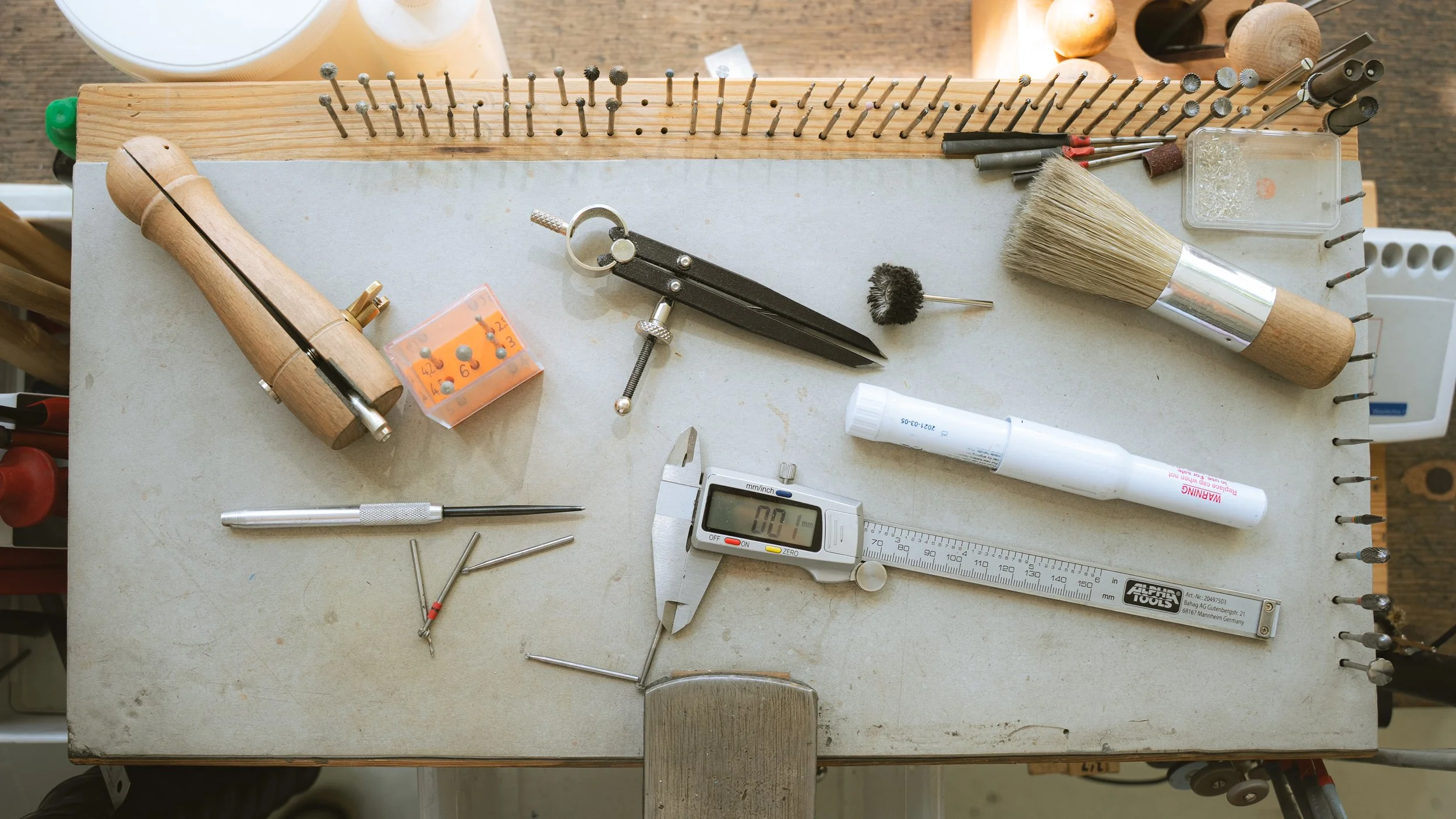
E: I think at some point you simply start doing something and then realize five years later that you’re still doing it because you genuinely enjoy it. I used to wear a lot of jewelry myself and spent loads of time browsing eBay Kleinanzeigen. Back then I could mostly only afford more delicate jewelry because solid pieces, especially in gold, were obviously extremely expensive. At some point I developed this strong desire to create my own jewelry collection that looked exactly the way I imagined it. Then I started asking my mom for the first basic tools for Christmas, and suddenly you find yourself buying expensive machines and thinking, okay, I guess I’m really doing this now.
A: What was the very first piece of jewelry you made?
E: My very first jewelry pieces actually never saw the light of day. They’re still lying somewhere in a drawer, I don’t even know exactly which one. They were just super basic, so they never made it out into this world.
A: What makes Larsen Jewelry special?
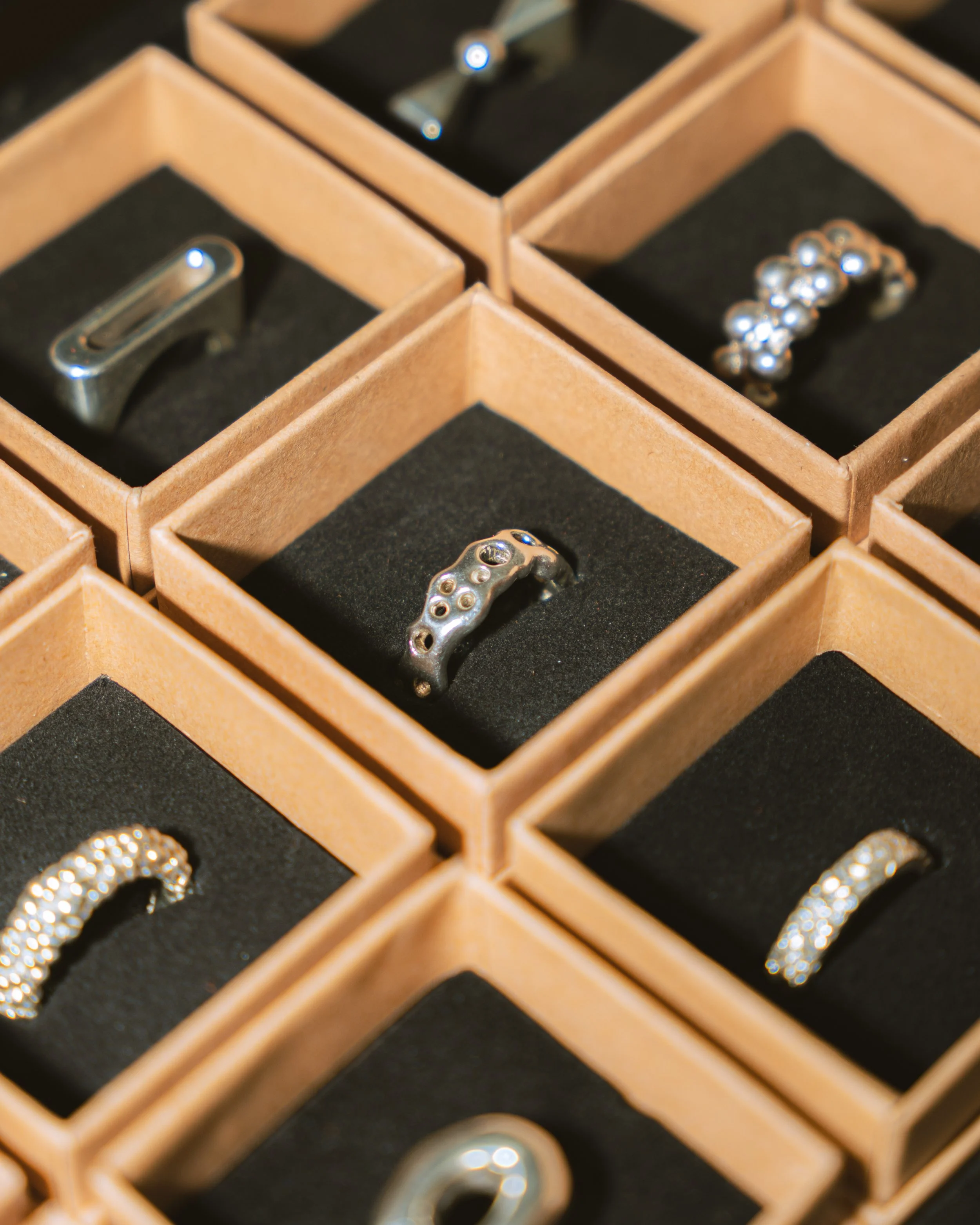
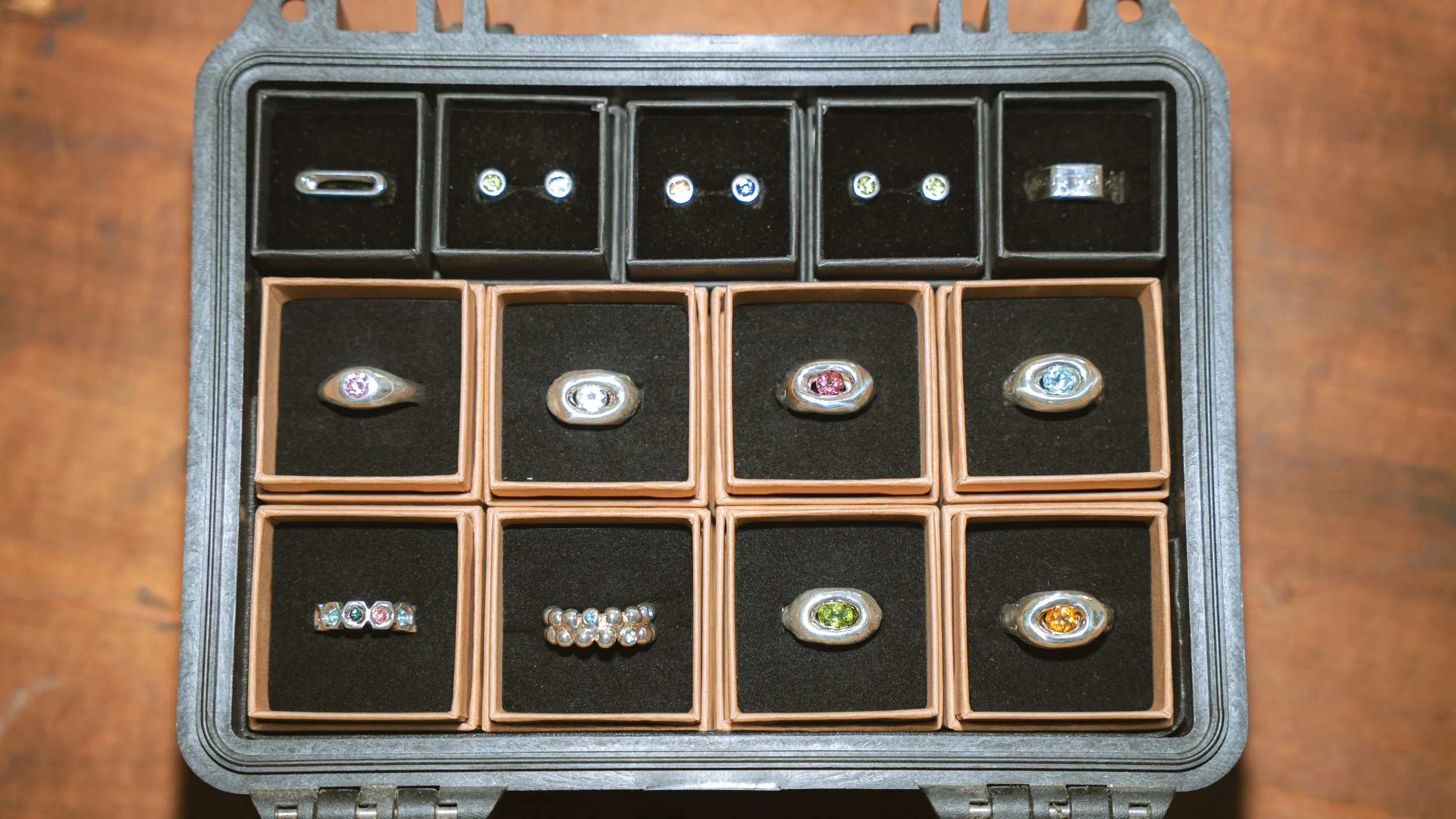
E: I think what makes Larsen Jewelry special is that many pieces are built around symmetry and repetition, but never in a perfectly identical way. Patterns and forms repeat themselves, yet each one has slight differences. Because of that, the pieces never feel too polished or sterile, they still carry something organic and alive.
A: What visually inspires you the most right now?
E: What inspires me visually tends to change in phases. Someone once told me that my work feels deeply connected to the symmetries found in nature, and that description immediately resonated with me. Since then, I’ve started seeing it more clearly myself. At one point, I was heavily inspired by futuristic furniture from the 1970s, especially the openings, curves, and sculptural forms you often see in those designs. You can probably recognize that influence in pieces like the 300 Degree Ring or the Steinlos Signet Ring. But inspiration also comes from very simple things. Often it’s just about mentally moving around geometric shapes or spheres and discovering new forms through that process. A lot of my ideas start there. Right now, I feel drawn toward creating more conceptual jewelry, pieces that carry subtle ideas or quiet messages behind them. That can easily become too sentimental or overworked, but I think when it’s approached in a minimal and understated way, it can become something really beautiful.
A: What do you want someone to feel when wearing your pieces?
E: I want people to simply feel beautiful wearing my pieces. One of my favorite moments is when someone tries on a piece and suddenly pauses for a second, that moment of realizing, “Shit Okay… I actually need this.”Not in a purely materialistic way, but because you can tell the piece gives them a certain feeling. Maybe it makes them feel more confident, more beautiful, or simply more like themselves. I always find that moment really special.
A: Do you think of jewelry more as a fashion piece or as a memory?
E: I think whatever I personally associate with a piece can eventually become completely irrelevant, because in the end the meaning is created by the person who buys it, wears it, or gives it to someone else. For some people, jewelry is simply a fashion piece, while for others it becomes deeply emotional. Someone might buy a ring after a breakup, someone else to celebrate an achievement, or simply because it makes them feel beautiful. And with engagement or wedding rings, of course, the meaning becomes something entirely different again. I do enjoy when a piece carries a small story or subtle idea behind it. For example, I made a ring loosely inspired by the one from Triangle of Sadness. Or my own gold ring weighs exactly 21 grams, supposedly the weight of the soul. That’s obviously a little random, but I liked the thought behind it. I’m drawn to those small meanings or quiet concepts attached to an object. One ring I made is called Hühnergott, inspired by naturally pierced stones that people used to place in chicken coops for luck or protection against evil spirits. Another piece references the German expression blauäugig sein meaning to be naive, though literally translated as “blue-eyed.” Babies often have blue eyes before their eye color changes, which somehow became linked to innocence or naivety. But I also used green and brown stones, because obviously naivety has nothing to do with eye color. Those kinds of subtle ideas are something I find really beautiful.
A: What would you say jewelry reveals about a person?
E: I think jewelry can say a lot about a person. Of course it always exists in combination with clothing and everything around it, but even on its own, jewelry can completely transform the way someone appears. You can wear pieces that feel extravagant or extremely minimal, pieces that look highly polished and luxurious or ones that feel raw and worn-in. All of that communicates something, either about who a person is or how they want to be perceived.
A: Do you think people wear jewelry differently today than they used to?
E: I do think the way people wear jewelry has changed. In the past, jewelry was often closely tied to family, tradition, or symbolic meaning. A classic signet ring, for example, might genuinely have represented a family lineage or been passed down through generations. Today, jewelry feels much more fluid. Emotional meaning still exists, of course, but many people now wear jewelry more as a form of self-expression, or simply because it reflects their personal style.
A: What’s something people might not immediately see about your work?
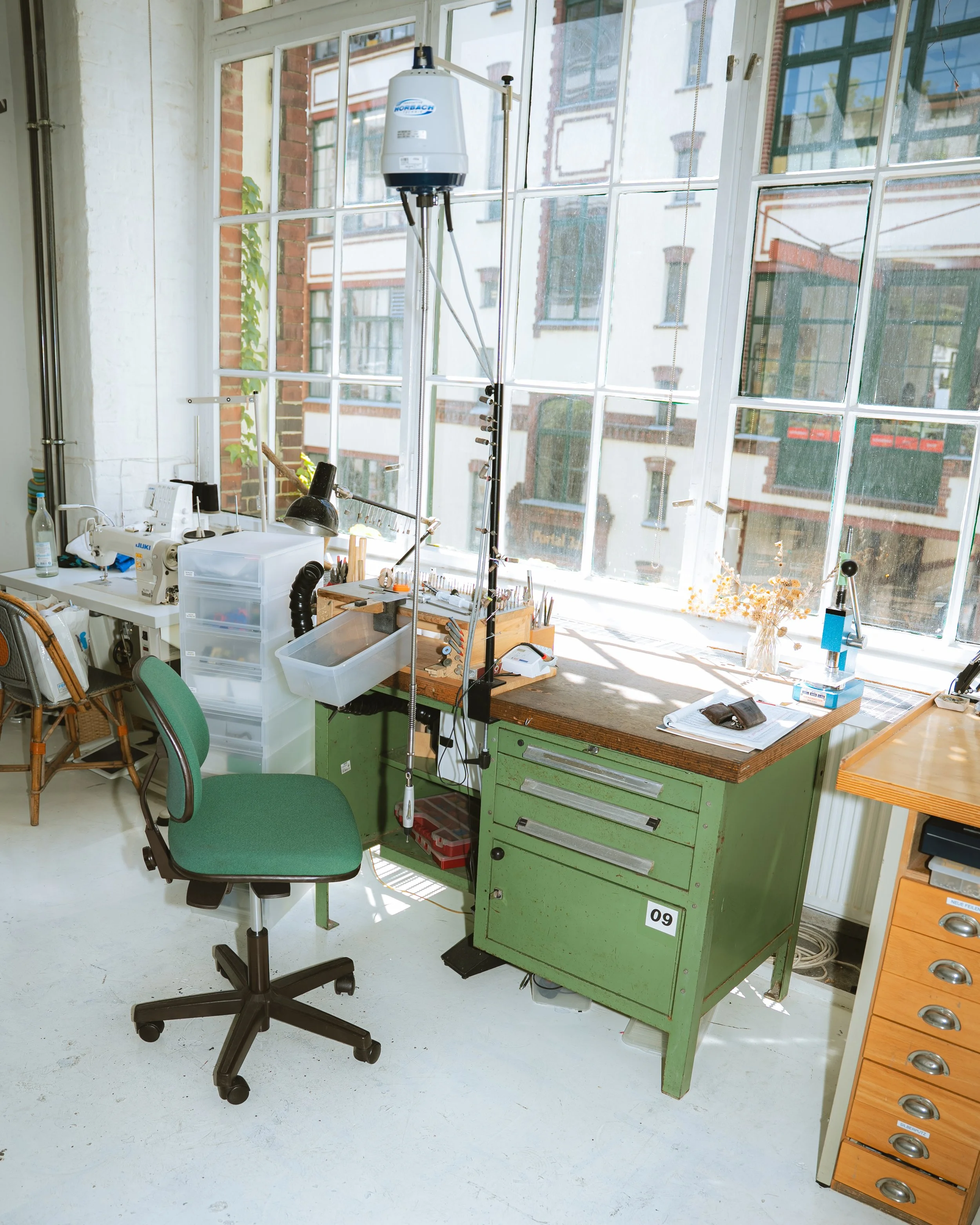
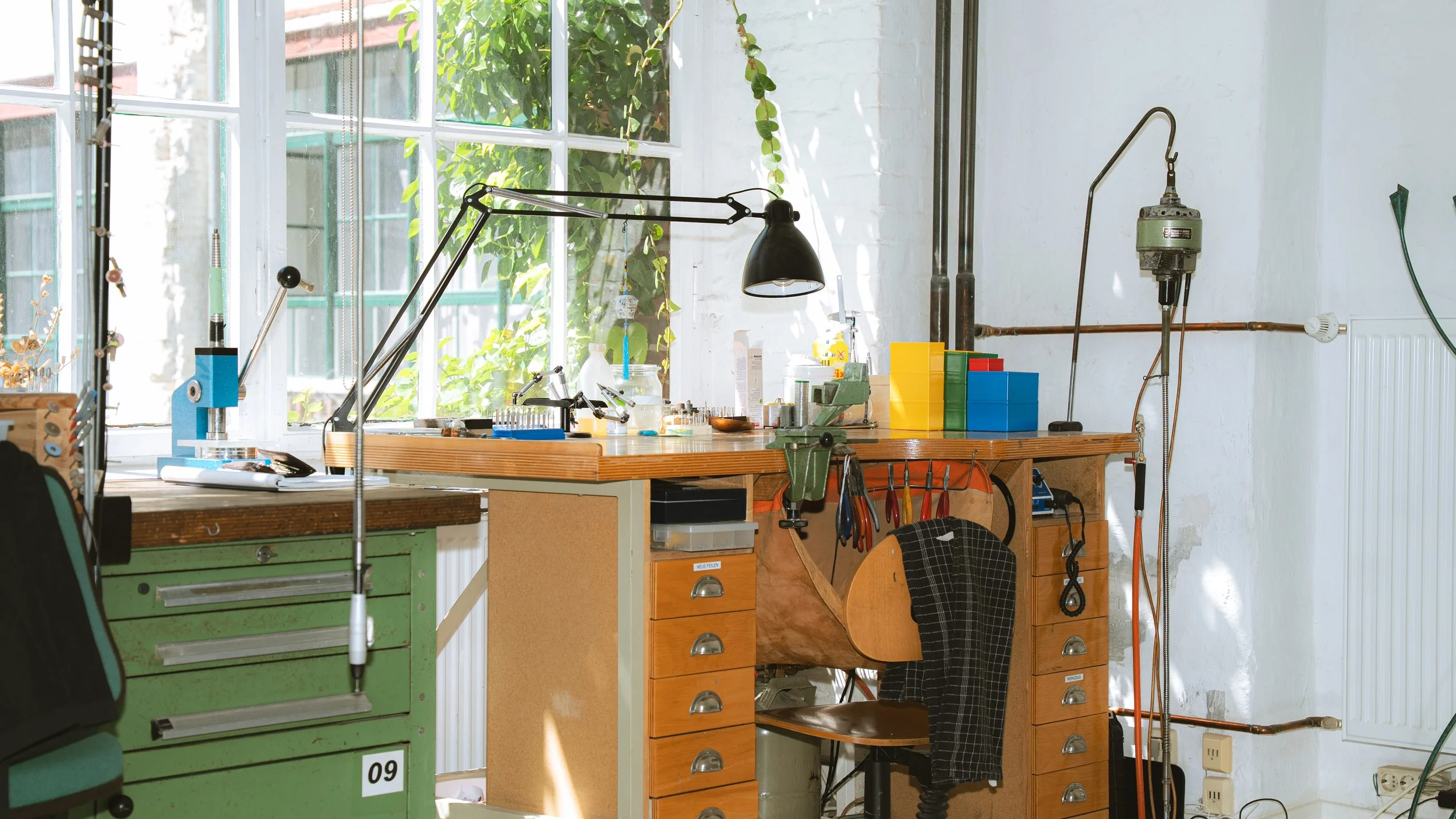
E: I think what people probably see the least is the reality of actually making the pieces, me standing in front of a polishing machine fully covered in a respirator mask, face shield, hoodie, and apron, looking like I’m cooking something illegal. Or those moments right at the end when I realize I still have to stamp a piece, completely mess it up, and instantly start cursing because it suddenly feels like I have to begin the whole thing again. I think people also don’t realize the small journey some rings go on before they ever reach someone. Some sit on my workbench for days, drive around Berlin with me in the car, or come along on random errands before eventually being finished, packaged, and sent out into the world.
A: Are there pieces that feel especially personal to you?
E: Yes, definitely. My own gold ring feels very personal to me. It weighs exactly 21 grams, supposedly the weight of the soul. Again, kind of random, but I loved the idea behind it.
A: Is there a piece you would never sell?
E: I think there are definitely certain pieces that would be harder for me to let go of. But in the end, I can usually remake most things for myself and reinterpret them in a slightly different way. The pieces that would actually be difficult to sell are probably the ones tied to very personal stories or custom engravings. Those naturally carry a completely different emotional weight.
A: Is there a piece of jewelry you wear every day yourself?
E: I’m currently working on a piece I’d genuinely love to wear every single day, a pearl bracelet I’m designing at the moment. I already wear the larger version all the time, but it’s still a little too heavy for everyday use, so now I’m trying to create a smaller, more effortless version of it. Other than that, there are always rings I end up wearing almost every day for a long time. The gold pearl ring, for example, or the gold fluid signet ring, I wore those forever. Right now I’m constantly wearing a colon ring with two different stones. There are always certain pieces that stay with me for a while and become part of my everyday life.
A: If you could design a piece of jewelry for anyone, who would it be?
E: Such a basic answer, but probably Brad Pitt. I actually once ended up standing right next to him on a red carpet and was this close to giving him one of my pearl pieces because I felt like it would perfectly fit the kind of jewelry he wears. He was maybe one or two meters away from me, and I just didn’t dare tap him on the shoulder. Looking back, it honestly feels so stupid. Maybe he wouldn’t have taken it anyway, but I still think about that moment sometimes. There’s even a video somewhere of me awkwardly standing there trying to work up the courage to hand him the ring. But honestly, I get just as excited when smaller artists or musicians wear my pieces. When people like Souly, Frau Gretel, or Malte Zierden suddenly show up wearing one of my rings, I find that incredibly special too.
A: What do you hope remains from your work?
E: I think it would be beautiful if some of my pieces were eventually passed down or even inherited. By now, I’ve made quite a lot of rings, so I like the idea that some of them might continue to exist for a very long time. Many of them are also made quite solidly, not overly delicate or fragile. Of course, jewelry also eventually returns to the recycling process and gets melted down again. But honestly, I find that beautiful too. There’s probably material in every silver bar that once belonged to old jewelry, coins, or objects from hundreds or even thousands of years ago. I really love the idea that these materials continuously transform and keep living on in new forms. And of course, there’s also a small desire to leave something behind, the thought that maybe, somewhere 200 years from now, one of my rings could still exist in the world.
by Noémi Zak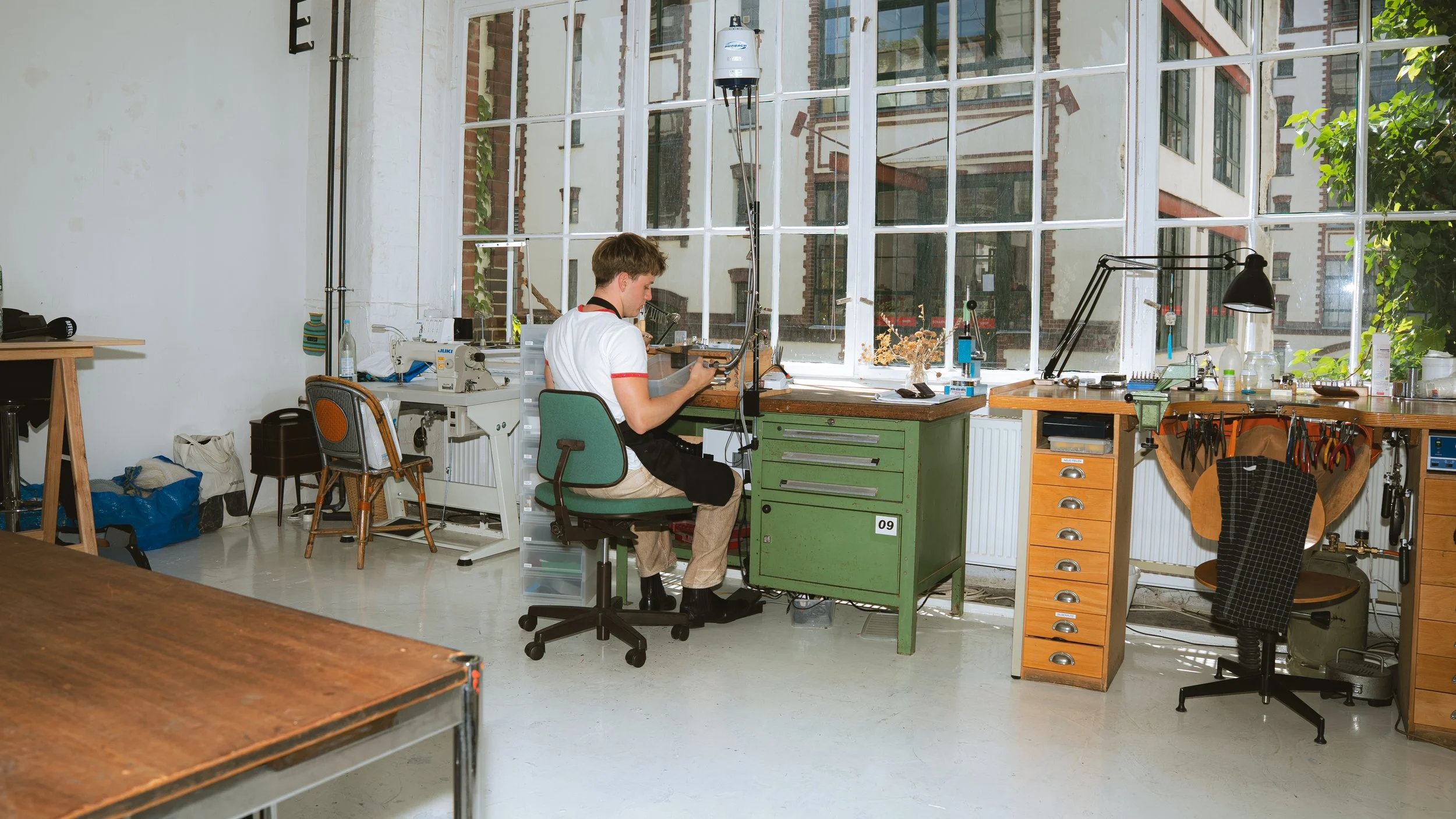
PHOTOGRAPHY by SVEN LYRCH